When preparing a slot car for competition or simply wanting it to run more smoothly, the transmission is one of the first areas to focus on. Within the transmission, the crown gear is the component that most influences how power is distributed between the motor and the axle. In setups with the motor parallel to the rear axle —what we call a sidewinder configuration in the slot world— the crown gear is the absolute protagonist: it receives the rotation from the pinion and transmits it directly to the axle, without additional direction changes. It seems simple, but making the right choice involves understanding attack angles, number of teeth, diameters, and materials.
At Ministry of Hobby, we work with these types of components daily, and we know that behind a seemingly simple question —"What crown gear do I need?"— lie variables that can make the difference between a car that runs and a car that wins. This guide is designed for any enthusiast, whether a beginner or a seasoned driver, to find concrete and useful answers before making their choice.
Crown gears are not universally interchangeable: the module, number of teeth, inner diameter, and type of attachment must match the motor pinion and the chassis you are using. An error in any of these parameters can result in excessive play, premature wear, or, directly, a transmission that does not engage. Therefore, it is advisable to understand the whole set well before buying based on price or intuition.
What is a crown gear and why is it so important
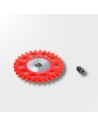
The crown gear is the largest gear within the transmission system of a slot car with sidewinder motorization. In this type of setup, the motor is placed parallel to the rear axle, with the pinion shaft perpendicular —or nearly perpendicular— to the wheel axle. The crown gear, mounted on the rear axle, meshes with the motor pinion and converts that rotational movement into traction for the wheels.
The reason this component has such weight in the car's behaviour is simple: the relationship between the number of teeth on the pinion and the number of teeth on the crown gear determines the gear ratio, that is, how many turns the axle makes for each turn of the motor. A longer ratio (crown gear with more teeth compared to the pinion) implies higher top speed but less acceleration. A shorter ratio favours corner exit and push, at the cost of some maximum speed.
In competition, fine-tuning that ratio is one of the most accessible and effective preparation tools. It does not require modifying the motor or the chassis: simply changing the crown gear or the pinion is enough to adapt the car to a specific circuit, to a layout with many curves, or to a fast track with long straights. This makes crown gears a strategic component, not just a mechanical one.
How to correctly choose a crown gear
Before focusing on brands or prices, there are four parameters you need to be clear about:
1. The module
The module defines the size of the teeth and must be identical on both the crown gear and the pinion for the meshing to be correct. In the slot world, the most common modules are M48 (48 teeth per inch, the most widespread in 1/32) and M64 (64 teeth per inch, finer, common in some high-precision setups). Mixing different modules is the most common mistake among beginners: the gears may seem to fit at first glance, but the wear is brutal and the transmission loses efficiency quickly.
2. The number of teeth
Together with the pinion, it determines the gear ratio. Crown gears for 1/32 slot cars typically range between 27 and 40 teeth, although there are variants outside this range depending on the brand and application. It is common for the chassis or kit manufacturer to specify a reference crown gear; from there, one can experiment by increasing or decreasing teeth to adjust the behaviour.
3. The inner diameter and type of attachment
The crown gear must fit precisely onto the rear axle. The most common inner diameter in 1/32 is 3/32" (2.38 mm), although there are also crown gears for 3 mm axles. Some are fixed with a grub screw, others use glue or a press fit. Check what system your chassis uses before purchasing.
4. Compatibility with the chassis and rail system
Not all crown gears fit all chassis. Cars designed to run on universal track (Scalextric, Ninco) or sport track (Scaleauto, Slot.it) may have different transmission geometries. Brands like NSR, Slot.it, or Scaleauto specify which chassis their crown gears are designed for, and this information must be respected.
Main types and differences
Within crown gears for slot cars, there are variants that respond to different needs:
Engineering plastic crown gears
These are the most common in standard equipment and many preparation kits. Materials like nylon or delrin offer a good balance between weight, quiet operation, and durability. They are easy to machine (if you need to adjust flatness) and their cost is low. Most crown gears from NSR, Slot.it, and Scaleauto fall into this category.
Metal crown gears
Less common in everyday use, but present in some high-competition applications. They offer greater dimensional precision and wear resistance, although they penalise weight and can be noisier. Their use makes sense when maximum performance and durability under stress conditions are sought.
Angled or specific profile crown gears
Some brands offer crown gears with an optimised tooth angle to reduce friction and heating during long sessions. They are a fine detail, but in competition, every tenth counts.
Technical aspects we should know
Beyond the purchasing parameters, there are technical concepts worth internalising to get the most out of crown gears:
Trueness
A crown gear that is not perfectly flat with respect to the axle introduces vibration and irregular meshing. Before mounting a new crown gear, many preparers check its trueness by spinning it on the axle and observing for wobble. If there is any, it can be corrected with a truing tool or simply by replacing the piece. NSR and Slot.it pay great attention to this aspect in their reference crown gears.
Backlash
The space between the teeth of the pinion and the crown gear should be minimal but present: too tight a fit generates heat and wear; too much backlash results in loss of efficiency and noise. The correct adjustment is noticeable when rotating the axle by hand: it should move smoothly but without perceptible play.
Lubrication
Technical plastic crown gears do not require abundant lubrication, but a small amount of specific slot gear grease at the pinion-crown contact point improves lifespan and reduces noise. Avoid low-viscosity oils: they migrate to the braids or tyres and create additional problems.
Centering on the axle
The lateral position of the crown gear on the axle affects alignment with the pinion. A crown gear offset to one side can cause asymmetric wear or even disengage under strong acceleration. Always check that the pinion and crown gear are perfectly aligned before finishing the assembly.
Practical tips for use, maintenance, and preparation
- Regularly check for wear. Microparticles of plastic from the pinion (or vice versa) accumulate on the crown gear teeth. Periodic cleaning with a dry brush or cloth prolongs the life of the set and keeps the meshing clean.
- Change the crown gear and pinion together when there is visible wear. Mounting a new crown gear on a worn pinion —or vice versa— accelerates the deterioration of the new piece.
- Experiment with the gear ratio before seeking other improvements. Changing the number of teeth on the crown gear is one of the most economical and effective ways to adapt the car to different circuits.
- Document your configurations. Note which crown gear and pinion you used on each track and the times achieved. Over time, that information is worth more than any generic advice.
- Apply grease judiciously. A small amount at the meshing point is sufficient. Excess attracts dirt and can contaminate the tyres if the car skids.
Common mistakes to avoid
- Mixing different modules. This is the most common mistake and the hardest to diagnose at first glance. Always check that the pinion and crown gear are of the same module.
- Mounting the crown gear without checking trueness. A warped crown gear generates vibration, noise, and premature wear. Two minutes of checking can prevent many headaches.
- Ignoring compatibility with the chassis. Not all 27-tooth crown gears are the same: the outer diameter, tooth profile, and type of attachment vary between brands. Always consult the manufacturer's specifications.
- Adjusting the pinion with too much or too little backlash. Both extremes harm performance. The correct adjustment is fine and noticeable to the touch.
- Over-lubricating. More grease is not better. Excess grease migrates and contaminates other parts, especially the tyres.
- Reusing a worn crown gear. It is tempting due to cost, but a crown gear with worn teeth penalises performance and deteriorates the new pinion much faster.
Recommendations for beginners and advanced users
If you are starting out
The most important thing is to respect the factory specification: mount the crown gear recommended by the chassis manufacturer, with the correct module and the indicated number of teeth. Do not experiment with gear ratios until you are clear on how the car behaves in its reference configuration. Brands like NSR or Slot.it include the appropriate crown gears for each chassis in their kits, which greatly simplifies the initial process.
When changing the crown gear for the first time, do so in a controlled manner: increase or decrease only 2-3 teeth from the base configuration and compare times. This way, you will start to understand how each change affects the actual behaviour of the car.
If you have experience
At this level, choosing the crown gear is part of the overall preparation of the car along with the motor, pinion, tyres, and weight distribution. Advanced preparers often have several crown gears of different teeth for each chassis and swap them according to the circuit layout: longer ratios for fast tracks with long straights, shorter for technical circuits with many slow corners.
It is also advisable to pay attention to the material: in long sessions or under high demands, a crown gear of higher dimensional quality —with better trueness and a more precise tooth profile— can make a difference in consistency and durability. The competition references from NSR, Slot.it, and Scaleauto are designed exactly for that use.
Comparative table: modules and common applications
| Module |
Common application |
Brands that use it |
User profile |
| M48 |
Standard and competition 1/32 |
NSR, Slot.it, Scaleauto, Avant Slot |
All levels |
| M64 |
High precision 1/32 / some specific kits |
Slot.it (some references) |
Advanced / competition |
Frequently asked questions about crown gears
What is the difference between a crown gear and an inline crown gear?
The crown gear is used in sidewinder setups, where the motor is parallel to the rear axle. The inline crown gear is used in inline setups, where the motor is perpendicular to the axle (in line with the car). The position of the motor determines the type of crown gear needed, and they are not interchangeable.
Can I use a Slot.it crown gear on an NSR chassis?
It depends on the module, inner diameter, and type of attachment. If both crown gears share those parameters, technically yes. But it is always advisable to check the specifications of each manufacturer before assuming compatibility.
How many teeth is typical for a crown gear for 1/32?
The most common range is between 27 and 40 teeth, with 32-34 teeth being a reference configuration in many standard setups. There are also options outside this range, but they are usually for specific uses.
How do I know if my crown gear is worn?
The clearest signs are teeth with a rounded or flat profile at the tip, irregular noise when rolling the car by hand, or loss of traction during acceleration. If you detect any of these symptoms, it is time to replace it.
How often should I change the crown gear?
It depends on usage. In regular competition, many preparers check the crown gear every 3-5 intense sessions. In recreational use, it can last many more hours if kept clean and well lubricated.
Does the crown gear affect the sound of the car?
Yes. A well-centered crown gear, with good trueness and properly adjusted to the pinion produces a smooth and regular sound. If the car sounds irregular or "gritty" while rolling, it may be a sign of defective meshing, wear, or lack of alignment.
Is a metal crown gear better than a technical plastic one?
Not necessarily. Delrin or engineering nylon crown gears offer excellent performance in most situations, with less weight and more quietness. Metal crown gears have advantages in precision and extreme durability, but their use makes sense in high-demand contexts. For regular use, quality technical plastic gears are the most balanced option.
Can I mix an M48 crown gear with an M64 pinion?
No. The modules must match between crown gear and pinion. Mixing them results in poor meshing, noise, accelerated wear, and loss of performance.
What happens if the crown gear has too much lateral play on the axle?
Lateral misalignment between the pinion and crown gear generates asymmetric wear and can cause the crown gear to disengage under strong acceleration. Adjust the lateral position with the appropriate washer or stop until achieving precise alignment.
Do I need special tools to change the crown gear?
In most cases, a hex screwdriver (for the attachment screw) and an axle puller if the crown gear is very tight are sufficient. Some crown gears are glued: in that case, you will need an appropriate solvent to loosen them without damaging the axle.
Should I lubricate the crown gear every time I mount it?
It is not necessary to lubricate it with every assembly, but it is advisable to apply a small amount of specific slot gear grease at the contact point before sessions. That is sufficient.
Are crown gears suitable for official competition?
Yes, as long as they meet the specifications of the relevant championship regulations. Each organisation may limit the number of allowed teeth or the type of material. Always check the regulations before preparing the car for competition.