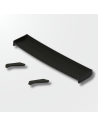
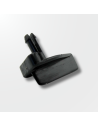
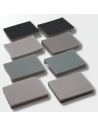
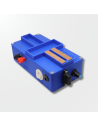
When we talk about serious slot preparation, the chassis is one of those elements that is frequently mentioned but not always fully understood. It is not a flashy component; it does not attract attention like a new motor or magnesium wheels, but its influence on the car's behaviour on track is much greater than it appears at first glance. The dampers and parts designed for the chassis are part of the rear suspension system of the slot car and are responsible for how the rear axle reacts to track irregularities, sharp direction changes, and transitions between straight and curve. If you have ever noticed that a car "dances" too much in chicanes, loses traction in slower corners, or does not plant the rubber well on the asphalt, there is a good chance that the chassis has something to say about it.
At Ministry of Hobby, we work with parts from brands like NSR, Slot.it, Scaleauto, and Avant Slot, all of which have catalogues of technical spare parts designed for enthusiasts who want to get the most out of their cars, both on home tracks and in federated competition. This section is aimed at those who already have some experience in the world of slot and want to delve into the mechanical preparation of their cars, although we also explain the basic concepts for those approaching this level of detail for the first time.
The components for the chassis mainly include dampers (also called springs depending on the manufacturer), material inserts that modify stiffness and dynamic behaviour, and in some cases, replacement chassis for specific chassis types. Each of these elements has a specific role, and their choice depends on the type of track, driving style, the regulations of the category in which you race, and the general setup of the car. There is no universal combination: you need to test, adjust, and understand what is happening on the track.
What is the chassis in a slot car and why is it important
The chassis is the structure that houses the rear axle and, in many modern designs, incorporates a floating or suspension system that allows the axle to move slightly independently of the chassis. This movement, although minimal, has direct consequences on the grip of the rear tyres on the track.
In competition slot cars, keeping both rear wheels in constant contact with the track is essential for homogeneous traction. Without any flexibility, any small irregularity in the circuit — a joint between track sections, a slight warping in a curve — would cause one wheel to lift momentarily, reducing traction and generating instability. The floating chassis, assisted by appropriate dampers, compensates for this.
Moreover, the chassis influences the height of the centre of gravity, the weight distribution between the front and rear axles, and the car's response to corner entries. A poorly balanced setup at this point can cause oversteer, understeer, or simply an unpredictable car that costs a lot of time on track.
How to correctly choose components for the chassis
The choice depends on several factors that should be analysed before purchasing:
- Type of chassis: not all chassis allow for a floating chassis. Classic rigid chassis do not have this system, while modern competition designs from NSR, Slot.it, or Scaleauto do incorporate it. Before looking for a specific damper, identify exactly what chassis you have and what chassis system it uses.
- Type of track: a home plastic track like Scalextric or Ninco (universal track) has very different characteristics from a professional resin or wood track (sport track). The behaviour of the dampers varies significantly depending on the surface and joints of the circuit.
- Hardness of the damper: dampers for the chassis are offered in different hardnesses (soft, medium, hard). A soft damper allows greater movement of the axle and improves grip on tracks with many irregularities; a hard one offers more consistency and response on very flat and well-leveled tracks.
- Competition regulations: if you race in a championship, always check if there are restrictions on the type of chassis, the materials allowed, or the dimensions of the component. Many local and national championships have very specific rules regarding this.
- Brand and model compatibility: although some components are relatively universal, many dampers and chassis are specific to a manufacturer or even a specific chassis model. Always check the exact reference before placing an order.
Main types and differences
Within the world of chassis for slot, we mainly find these types of components:
Rubber or silicone dampers
These are the most common and the easiest to swap. They are placed between the chassis and the chassis to limit and dampen the vertical movement of the axle. They are offered in different hardnesses and have a relatively short lifespan: rubber hardens over time and with heat, so it is advisable to check them periodically and replace them when they lose elasticity.
Metal springs
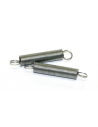
They offer a more predictable and consistent response than rubber ones and age better. They are the preferred option in high-level competition due to their reliability. The hardness adjustment is more precise but also more technical: you need to know the car's setup well to make the most of them.
Replacement chassis
Some manufacturers offer complete chassis as spare parts, in different materials (plastic, nylon, delrin) and with different geometries. Changing the chassis can be a solution when the original is worn out or when you want to try a different configuration more radically.
Inserts and spacers
Small pieces that allow you to modify the height of the chassis, the preload of the damper, or the angle of the axle. They are the fine-tuning components par excellence and are widely used in competition preparation to refine the setup session by session.
Technical aspects we need to know
To understand how the chassis works well, there are some technical concepts that should be clear:
- Axle float: this is the range of vertical movement allowed by the chassis. Greater float implies greater adaptability to the track, but it can also translate into less precision in fast corners.
- Preload: this is the initial tension applied to the damper before the car is on track. A high preload means that the damper only works in response to more severe impacts; a low preload activates it in response to any minimal irregularity.
- Centre of gravity: the position of the chassis relative to the chassis directly influences the car's centre of gravity. A lower chassis reduces the centre of gravity and improves stability, especially in inline motor configurations, where the motor already helps to lower the weight.
- Weight distribution: the weight on the rear axle conditions traction. A car with too much weight at the front will tend to understeer; with too much at the back, it will tend to oversteer. The chassis and its components are part of this balance.
- Compatibility with the motorisation: the type of motor mounting — sidewinder, inline, or anglewinder — determines how the motor relates to the chassis and what margin for adjustment there is. In a sidewinder setup, the motor is parallel to the rear axle, and the chassis works in a certain way; in inline, it is perpendicular to the axle and generally lower; in anglewinder, it is at an angle, with characteristics specific to each design.
Practical tips for use, maintenance, and preparation
- Inspect the condition of the damper before each important session. Rubber dampers lose properties with accumulated heat. If you notice that the car's behaviour has changed without apparent reason, the first thing to check is the chassis.
- Clean the chassis area regularly. Tyre dust and lubricant residues can affect the functioning of the floating system. A gentle cleaning with a dry cotton swab is sufficient to keep it in good condition.
- Do not overtighten the screws that secure the chassis. Excessive tightening can block the float and nullify the effect of the damper, leaving the axle rigid without it being noticeable at first glance.
- Always bring spare dampers to races. They are small, cheap parts that are easy to change in the pit. Losing a heat due to a blown damper is something that can be easily avoided.
- Test different hardnesses in free practice before deciding on the race setup. What works on one track may not work on another, even if the regulations are the same.
Common mistakes we should avoid
- Buying dampers without verifying exact compatibility. This is the most common mistake. An NSR damper may not be suitable for a Slot.it chassis even though both are reference brands. Always check the specific reference of the chassis.
- Ignoring the wear of rubber dampers. At first glance, they may seem fine, but if they have many hours of running, they have lost the necessary elasticity. Change them preventively.
- Using the softest damper thinking it is always better. An excessively soft damper on a flat track can generate uncontrolled movement of the axle that harms stability in fast corners.
- Mixing components from different systems without informing yourself. There are parts designed for specific geometries of each brand — Scalextric, Scaleauto, Ninco, Carrera — that are not interchangeable even if they look similar.
- Not adjusting the setup after changing the chassis. Modifying a component of the chassis alters the overall balance of the car. It is advisable to also check the height of the guide, the weight on each axle, and the hardness of the tyres after any change in this system.
Recommendations for beginners and advanced users
If you are starting
The most important thing at the beginning is to understand what type of chassis you have and whether it already incorporates a floating chassis system. Many beginner cars have rigid chassis where this section does not apply. If you already have a competition car from brands like NSR or Slot.it, it is best to start with the dampers recommended by the manufacturer for that specific chassis — they are usually medium hardness — and not modify anything else until you have enough runs to notice differences. Preparation is a gradual process.
If you already have experience
Working with the chassis at an advanced level involves having a clear testing method: change one element at a time, time it, compare, and repeat. Many preparers keep a small record of setups by track where they note which damper they used, under what conditions, and with what result. Over time, that accumulated knowledge is worth more than any new part. It is also worth exploring fine-tuning inserts and alternative chassis offered by brands like Scaleauto or Avant Slot for their competition chassis.
Frequently asked questions about chassis components
Do all slot cars have a floating chassis?
No. Beginner cars and many collector models have rigid chassis without a floating system. The floating chassis is a feature of competition and high-end cars.
When should I change the rubber dampers on my chassis?
As a general rule, it is advisable to check them every 10-15 hours of intensive running or before each important championship. If you notice changes in the car's behaviour without having modified anything else, first check the condition of the dampers.
Can I use dampers from one brand on the chassis of another?
It depends. Some are relatively interchangeable in size and hardness, but you should always verify the exact measurements and compatibility with the geometry of the chassis. Do not assume compatibility without checking.
What is the difference between a soft damper and a hard one?
The soft one allows greater movement of the axle and adapts better to tracks with irregularities; the hard one limits movement and offers more consistency on very flat tracks. Neither is better by default: it depends on the conditions of each circuit.
Does the chassis influence the car's top speed?
Directly, not much. Its main influence is on traction and stability, which do translate into faster lap times, especially in corners and chicane exits.
Do I need to change the chassis if I change the motor?
Not necessarily, but it is advisable to review the complete setup. Changing the type of motorisation (for example, switching from sidewinder to inline) may require adjustments to the chassis because it changes the weight distribution and the geometry of the assembly.
Are Slot.it chassis compatible with NSR chassis?
Generally, no. Each manufacturer designs its chassis for its own chassis. Although some measurements may coincide, this is not something that should be assumed without verifying it with the specifications of each part.
What material is better for a competition chassis: nylon, delrin, or standard plastic?
Delrin (polyacetal) is the preferred material in competition due to its rigidity, low friction, and dimensional stability against temperature changes. Nylon is more flexible and absorbs vibrations better. Standard plastic is valid for home or beginner use.
How does the chassis affect behaviour in fast corners versus slow corners?
In fast corners, a stiffer chassis usually offers greater stability. In slow corners and chicanes, greater float helps both wheels maintain contact with the track by reducing speed and increasing relative lateral load.
Can I fine-tune the preload of the damper without changing the part?
Yes, in some chassis designs, you can adjust the preload using inserts or varying the mounting position. Check the manual or technical guide of the chassis you are using.
How often should I clean the chassis area?
After each long session or before an important race is a good practice. It is not necessary to disassemble it completely: a superficial cleaning of accumulated residues is sufficient in most cases.
Is it worth investing in a high-end chassis for a home track?
If you mainly race at home with friends occasionally, standard components are probably more than sufficient. The real difference is felt in timed competition, where tenths of a second matter, and the consistency of the car throughout a complete heat makes the difference.