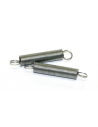
There are parts that, due to their size, go unnoticed until they fail. The braids are one of them. These small flexible conductors that touch the track and carry current to the motor are largely responsible for a car responding in a linear, precise manner without interruptions. Replacing them with higher quality ones, or simply choosing the right ones for your type of track and driving style, can make a real difference in the car's behaviour: from trigger response to stability at high speeds.
If you have been in the slot world for a while, you will know that not all braids behave the same. And if you have just started, this is one of those spare parts that is worth understanding well from the beginning, as they directly affect the driving experience and the wear of other components. On this page, we will tell you everything you need to know to make the right choice.
What are braids and why are they important
Braids are flexible electrical conductors that are housed in the guide of the slot car and are in permanent contact with the metal rails of the track. Their function is to transmit electrical current from the rail to the motor, completing the circuit that brings the vehicle to life.
They may seem simple —and in a way they are— but their role is absolutely critical. Without good electrical contact, the current reaches the motor irregularly, resulting in speed losses, erratic responses to the controller, and, in extreme cases, sudden stops during a race. A set of worn or poorly chosen braids can ruin a racing session even if the rest of the car is perfectly prepared.
Additionally, braids act as a programmed wear element: they are designed to be the component that "sacrifices" itself in contact with the rail, thus protecting the guide and the motor itself. This means that it is advisable to always have them on hand and check them regularly.
How to choose braids correctly
The choice depends on several factors that should be evaluated together:
- Compatibility with the guide: Braids must fit correctly in your car's guide. Each brand (NSR, Slot.it, Scaleauto, Avant Slot…) has its own guide measurements, and although there is some interchangeability, it is advisable to verify this before purchasing.
- Type of rail: It is not the same to race on universal rail (Scalextric, Ninco) as on sport rail (Scaleauto, Slot.it). The width and shape of the rails determine the most suitable type of braid.
- Stiffness and rigidity: A stiffer braid offers greater contact pressure, which can be advantageous on tracks with irregular rails or a lot of accumulated dirt. A softer and more flexible braid adapts better to changes in track level and is usually the preferred option on well-maintained circuits.
- Conductor thickness: A larger cross-section means lower electrical resistance and greater current-carrying capacity. For more powerful motors or motors that consume more (such as advanced competition motors), a braid with a larger cross-section may be interesting.
- Intended use: A casual session at home is not the same as a race in a club or championship. For competition, many drivers prefer higher quality braids and inspect them after each race.
Main types and differences
There are several types of braids on the market that differ mainly by their construction, material, and driving characteristics:
Standard braids
These are the ones that come as standard with most cars. They work correctly for recreational use, but in many cases, drivers replace them from the very beginning with more specific options. They are perfectly valid for getting started and understanding the car's base behaviour.
Competition braids
Manufactured with materials of higher conductivity and with more precise geometry. They offer lower electrical resistance and better response. Brands like NSR, Slot.it, or Scaleauto offer braids of this type, specifically designed for their guides and tested in real competition environments.
Long and short braids
The length of the braid influences how it "sweeps" the rail during turns. Longer braids tend to maintain contact for longer when taking a turn, while shorter ones offer greater precision but may lose contact in tight corners if the guide geometry is not appropriate.
Material-based braids
Most are made from copper or copper alloys due to their excellent electrical conductivity. Some variants incorporate coatings or surface treatments to reduce friction or improve durability.
Technical aspects we should know
To get the most out of braids, there are some technical concepts that are worth keeping in mind:
Electrical resistance
The resistance of the braid is part of the total resistance of the car's electrical circuit. A worn, dirty, or oxidised braid can significantly increase this resistance, reducing the power that reaches the motor. In competition cars, where maximum performance is sought, this detail matters.
Contact pressure
The braid must press gently but consistently against the rail. Too much pressure generates greater friction and accelerated wear; too little pressure causes current cuts. The geometry of the guide and the braid's own tension determine this balance.
Relationship with the guide
The guide and the braids work as a system. If you mount new braids on a worn guide or one with excessive play, the result will not be as expected. It is advisable to check both components at the same time.
Impact on controller response
A more efficient electrical transmission translates into a more linear response to the trigger. This is especially noticeable in braking and progressive accelerations, where current cuts can cause the car to behave unpredictably.
Practical tips for use, maintenance, and preparation
Braids are inexpensive and easy to change, so there is no excuse for not keeping them in perfect condition. Here are the tips we apply ourselves:
- Regular inspection: Check the condition of the braids before each important session. Look for excessive wear, deformations, or accumulated dirt. A crushed braid will not regain its original shape.
- Cleaning the rail: Part of the maintenance of the braids involves keeping the rail clean. A rusty or dirty rail wears the braids much faster and generates poorer electrical contact.
- Preventive replacement: In competition, many drivers change the braids before each long race or championship, regardless of their visual condition. It is a minimal cost compared to the risk of a failure during the race.
- Tension adjustment: Some braids allow for slight tension adjustments by bending them carefully. Do not force the material: if the braid no longer has sufficient tension, it is best to replace it.
- Initial run-in: New braids may need a small run-in period to settle properly on the rail. A few laps at moderate speed are usually sufficient.
Common mistakes to avoid
We have been seeing the same mistakes repeated for years. Here are the most common ones so you don't fall into them:
- Ignoring the braids until the car fails: This is the most common mistake. Braids wear out gradually, and the deterioration of driving can go unnoticed. By the time there is an obvious cut, the wear has already been affecting performance for some time.
- Buying braids without checking compatibility: Not all braids work with all guides. Before purchasing, check the brand and model of your guide, or the car for which you need them.
- Using deformed braids: If a braid has suffered a strong impact or is crushed, discard it. Trying to recover it may result in irregular contact, which is worse than having no contact at all.
- Mixing types without criteria: Some drivers mount braids of different brands or characteristics on the same car "to try". If you do not control the variables well, it is difficult to know what is influencing the behaviour.
- Forgetting to clean the contact area: Accumulated dirt between the braid and the guide, or between the braid and the rail, reduces electrical efficiency. A quick clean with a dry cloth or a bit of contact cleaner can make a difference.
Recommendations for beginners and advanced users
If you are starting
Start by using the braids that come standard with your car. Learn to identify when they are worn out and familiarise yourself with the replacement process, which is simple but requires some skill. Once you have some experience, try the braids from your car's own brand (NSR, Slot.it, Scaleauto…) to notice the difference compared to the standard ones. It is not necessary to go straight to the most technical option: the important thing is to always have a spare set on hand.
If you already have experience
At an advanced level, braids are part of the car's setup just like tyres or the height of the body. Experiment with different stiffness and lengths depending on the type of circuit and the power of the motor. On tracks with irregular rails or many curves, a more flexible braid can compensate for imperfections. On fast circuits with well-maintained rails, a stiffer braid with low electrical resistance can give you that tenth of a second that makes the difference. Always bring several sets to club or championship races.
| Feature |
Standard braid |
Competition braid |
| Conductivity |
Medium |
High |
| Flexibility |
Variable (usually medium) |
Optimised by model |
| Durability |
Correct for casual use |
High, designed for intensive use |
| Compatibility |
Generic or standard |
Specific by brand/guide |
| Price |
Low |
Medium-low (still affordable) |
| User profile |
Beginner, recreational use |
Club driver, competition |
Frequently asked questions about braids
How often should braids be changed?
It depends on usage and the type of track. In casual use, they can last many sessions. In competition, it is advisable to check them after each long race and change them preventively on important days. If you see visible wear or loss of tension, change them without hesitation.
Are all braids universal?
No. Although there are more common sizes that are compatible with several guides, each brand usually has its own specifications. Before buying, check compatibility with your guide and car model.
Do braids affect top speed?
Yes, indirectly. A braid with higher electrical resistance reduces the power that reaches the motor. In competition cars, where maximum performance is sought, this detail can influence top speed and acceleration response.
Can I use NSR braids on a Slot.it car?
In many cases yes, as long as the guide has the same housing dimensions. Both brands use sport rail and their guides are often interchangeable, but it is advisable to verify this for your specific model.
Do braids influence the stability of the car?
Directly, they do not condition dynamic stability. However, irregular electrical contact can cause erratic responses to the trigger that the driver may confuse with a mechanical setup problem. Good electrical contact is the foundation upon which to build any adjustment.
Which is better, long or short braids?
Long braids tend to maintain contact better in turns, especially in tight corners or on circuits with many chicanes. Short ones are more precise but require very well-adjusted guide geometry. For beginners, the standard length braids from each brand are a good option.
Can braids be cleaned?
Yes. If they are dirty but in good condition, you can clean them with a dry cloth or with an electrical contact cleaner. What cannot be recovered is the physical wear of the material or deformation from impact.
Will I notice a difference when switching from standard braids to competition ones?
In most cases, yes. The response to the trigger is usually cleaner and the driving is more predictable. It is one of the most economical changes you can make to a car with the greatest return in driving sensations.
Should braids be lubricated?
No. Braids work by direct electrical contact with the rail. Applying lubricant in that area would reduce conductivity. What you can do is keep the rail clean to ensure that contact is as efficient as possible.
Do braids influence the wear of the guide?
A braid with too much tension or poorly positioned can generate extra friction on the guide. That is why it is important to always mount compatible and well-maintained braids and check that they sit correctly in their housing.