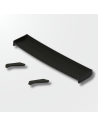
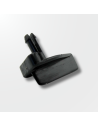
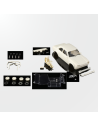
When preparing a car for competition —or simply wanting it to run cleanly and without going off on a club track— the details of geometry matter much more than they appear. One of those details, often underestimated by novice drivers, is the height at which the guide works relative to the track. If the guide is too high, the car loses lateral traction in corners, the braids lose contact with the copper strips, and driving becomes erratic. If it is too low, the chassis scrapes the track, generating unwanted friction and potentially deforming parts with use.
Spacers are the pieces that solve exactly that problem. They are precision washers —also called guide spacers— that are placed between the guide pivot and the chassis to precisely regulate how much the guide "drops" into the track. Their appearance is discreet, their price is low, but their influence on the car's behaviour is directly proportional to the precision with which you choose them.
At Ministry of Hobby, we work with spacers made from different materials and thicknesses because we know that there is no one-size-fits-all: each combination of chassis, guide, and type of track requires a different adjustment. Whether you are preparing a car for a club race night or fine-tuning the geometry of a competition single-seater, here you will find the exact spacer you need.
What are guide spacers and why do they influence behaviour so much
A guide spacer is essentially a controlled thickness washer that is interposed in the guide assembly to modify its vertical position within the pivot. Although its technical name is "spacer," in workshop jargon, they are also simply called "shims" —a widely used Anglo-Saxon term in tuning forums.
Their main function is twofold. On one hand, they eliminate the vertical play that may exist between the guide and its housing in the chassis: this play, even if it is just a few tenths, causes the guide to "dance" slightly during the race, generating irregular contact with the track and loss of stability. On the other hand, they allow you to adjust the pressure with which the braids rest on the power strips, which directly influences electrical continuity and, therefore, the motor's response.
A correct assembly of the spacers ensures that the guide always works at the same depth, with a firm and uniform braid support, and that the front of the car does not "peck" or lift in high-speed sections. The result is more predictable driving, fewer off-track incidents, and, in a timed context, more consistent lap times.
How to correctly choose spacers
The choice depends on three factors that need to be analysed together: the car's chassis, the type of guide installed, and the track system you will be running on.
The chassis
Each chassis has a guide housing with its own depth and clearance. Standard plastic chassis usually come with some factory play to facilitate assembly; aluminium or competition chassis tend to work with tighter tolerances. Measure the actual play before choosing the thickness: with a tenth too much, you can block the lateral movement of the guide, and with a tenth too little, the problem persists.
The type of guide
Standard competition guides (such as those from NSR, Slot.it, or Scaleauto) have slightly different pivot heights. A high guide needs more separation for the braids to reach the strips properly; a low guide may need less or even no additional spacer. Always check the manufacturer's specifications for the guide as a starting point.
The track system
It is not the same to prepare a car for universal track (Scalextric, Ninco) as for sport track (Scaleauto, Slot.it). The depth of the track varies between systems, and that directly affects how much the guide should "drop." If you are going to run on several systems, it is ideal to have spacers of different thicknesses and adjust according to the circuit.
The material of the spacer
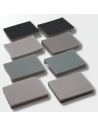
The material affects the weight you add to the assembly and the durability of the piece. Brass spacers are heavier but extremely durable and resistant to deformation; plastic ones are lightweight and sufficient for regular use; fibre spacers offer a middle ground and are common in competition setups where every tenth of a gram matters.
Main types and differences
Although all spacers serve the same basic function, there are relevant differences that are worth knowing before ordering:
By material
- Brass: the most resistant and precise. It does not deform with heat or mounting pressure. Recommended for competition setups where the piece will not be changed frequently.
- Plastic: lightweight and economical, sufficient for recreational use and regular running. It may deform slightly over time if the mounting pressure is high.
- Fibre: a balance between weight and rigidity. Widely used in club and semi-professional setups. It does not add significant weight and maintains dimensions well.
By thickness
The most common thicknesses range from 0.1 mm to 0.5 mm, in increments of 0.1 mm. Some manufacturers also offer intermediate sizes (0.15 mm, 0.25 mm) for finer adjustments. It is common to use one or several stacked spacers to reach the desired play, although it is advisable not to exceed three stacked pieces to avoid compromising the stability of the assembly.
By inner diameter
The central hole of the spacer must fit the diameter of the guide pivot you are using. The most common competition guides have pivots of 2 mm or 2.5 mm; always check the measurement before ordering to avoid the spacer being loose or, conversely, not fitting.
Technical aspects we need to know
To make real use of spacers, it is important to understand two related concepts: vertical play and braid pressure.
Vertical play of the guide
It is defined as the free movement that the guide has in a direction perpendicular to the track. Ideally, the guide should be able to move slightly laterally (to navigate corners) but not vertically. If you notice that the guide "goes up and down" when pressed with your finger, you have vertical play that needs to be corrected with spacers.
To measure the play, simply mount the car on the track and observe if the front "pecks" in the straight sections or if the car tends to slide the front outwards in fast corners. Both symptoms usually indicate a lack of pressure in the guide.
Braid pressure
The braids need to maintain firm but not excessive contact with the track strips. If the guide is too high, the braids barely touch the strips and the electrical supply becomes intermittent: the car "flickers" or responds with a delay to the controller. If the guide is too low, the braids may bend backwards with the movement of the car, generating additional resistance and premature wear.
The optimal point is where the braids firmly support the strips throughout the lap, without the base of the guide scraping the bottom of the track. Spacers allow you to find and fix that point.
Practical tips for use and preparation
- Start by measuring: before installing any spacer, use a digital caliper to measure the current play between the guide and its housing. This way, you know exactly what thickness you need instead of going in blind.
- Stack wisely: you can combine two or three spacers of different thicknesses to reach the exact measurement, but ensure that the assembly is as solid as possible. An unstable stack may move during the race and nullify the adjustment.
- Check lateral movement: after assembly, verify that the guide still rotates freely in the horizontal direction. If you notice it is "stuck," you have tightened too much or added excessive thickness.
- Adjust according to the circuit: if you frequently switch between universal track and sport track, keep a set of spacers for each configuration and label them. You will save time in the paddock.
- Check after each long session: heat and vibrations can slightly loosen the assembly. A quick look at the guide at the end of each running session will prevent surprises in the next race.
- Clean before mounting: any residue of grease or dust between the spacer and the chassis can falsify the adjustment. Clean the surfaces with isopropyl alcohol before installing the piece.
Common mistakes to avoid
Using a spacer of incorrect thickness "by eye"
This is the most common mistake. Without measuring the actual play, it is almost impossible to choose the correct thickness on the first try. Spending two minutes measuring with a caliper saves you several laps of trial and error on the track.
Ignoring the inner diameter
A spacer with too large a hole will be loose around the pivot and may shift during the race, nullifying the adjustment. Always check that the inner diameter of the spacer fits your guide's pivot.
Stacking too many spacers
More than three stacked spacers usually indicates that there is another problem with the assembly (inadequate guide for that chassis, worn housing…). Instead of continuing to add pieces, analyse the root of the problem.
Confusing vertical play with other handling issues
A car that frequently goes off track may have dozens of causes. Spacers solve the vertical play of the guide, but do not compensate for a bent axle, worn tyres, or incorrect weight distribution. Ensure you diagnose correctly before intervening.
Not checking after assembly
Installing the spacer and going straight to the track without checking that the guide rotates freely and the braids are resting correctly is a recipe for continuing to have the same problem or, worse, creating a new one.
Recommendations for beginners and advanced users
If you are starting
The simplest approach is to start with the spacers recommended by the manufacturer of your guide or chassis. If your car is stock and you notice it "pecks" in fast corners or the braids lose contact, a spacer of 0.1 mm or 0.2 mm is usually the safest starting point. Use plastic spacers to begin with: they are economical, easy to install, and allow you to experiment without fear of damaging anything.
Dedicate a specific session to adjustment: place the spacer, run 10-15 laps, and evaluate the behaviour before changing anything else. If you make several changes at once, you won’t know which one had an effect.
If you already have experience
Advanced drivers often work with brass or fibre spacers for greater precision and durability. It is common to have a small kit with thicknesses from 0.1 to 0.5 mm in each material to adjust according to the circuit, track conditions, and the car being run.
In high-performance setups with cars from brands like NSR, Slot.it, or Scaleauto, adjusting the guide is part of the "tuning" process along with weight distribution, tyre hardness, and gear ratio. Always having a complete set of spacers on hand is as basic as bringing a set of tools to the paddock.
| Material |
Weight |
Durability |
Recommended use |
Approximate price |
| Plastic |
Very low |
Medium |
Recreational use, beginners |
Economical |
| Fibre |
Low |
High |
Club, semi-professional |
Medium |
| Brass |
Medium |
Very high |
Competition, fine tuning |
Medium-high |
Frequently asked questions about guide spacers
How many spacers can I stack?
It is common to use between one and three. More than three usually indicates that there is another problem with the assembly that needs to be resolved before continuing to add pieces.
Are spacers universal or do they depend on the guide model?
They depend on the inner diameter of the pivot. Before ordering, check what pivot size your guide uses (usually 2 mm or 2.5 mm) and choose the spacer with the corresponding hole.
Do spacers affect the weight of the car?
In materials like plastic or fibre, the added weight is practically negligible. Brass spacers add a bit more, but they are still pieces of grams. In high-level competition, this is taken into account in the weight distribution calculation.
Do I need spacers if my car is for recreational use?
It is not essential, but if you notice that the car "pecks," frequently loses electrical contact, or goes off track for no apparent reason, checking the guide's play with a spacer can solve the problem simply and cheaply.
Can I use spacers of different materials stacked?
Yes, it is perfectly valid to combine, for example, a fibre spacer and a plastic one to reach a specific thickness. The important thing is that the assembly is stable and there are no gaps between the pieces.
Are spacers suitable for all track systems?
The spacer itself is compatible with any system, but the optimal thickness varies according to the track: sport track (Scaleauto, Slot.it) and universal track (Scalextric, Ninco) have different depths, so the ideal adjustment may differ.
How often should I check the spacers?
After long running sessions or before an important race. With heat and vibrations, the assembly may loosen slightly; a quick check ensures that the adjustment remains correct.
What happens if I install a spacer that is too thick?
The guide may become blocked laterally, preventing the car from navigating corners correctly. In extreme cases, it may damage the pivot or the chassis housing. It is always better to start with a smaller thickness and add if necessary.
Can I make my own spacers?
Technically yes, but dimensional precision is key. A homemade spacer with irregular thickness may create more problems than it solves. Quality commercial spacers are so inexpensive that it rarely makes sense to make them at home.
Do spacers affect the wear of the braids?
A correct adjustment extends the lifespan of the braids because it prevents them from working at incorrect angles or with excessive pressure on the track strips. A poor adjustment —whether too much or too little— accelerates wear.