In the transmission of a slot car, there are components that go unnoticed until you start to understand how the mechanical assembly truly works. Pulleys are one of them. If you have been preparing cars for a while or are making the leap from track driving to technical tuning, you will have noticed that the gear ratio, the material of the pulley, and its correct alignment make a real difference in the engine response, cornering torque, and top speed. It is not a luxury component: it is a functional piece that, when well chosen, transforms how the car behaves.
Belts are common in inline and anglewinder configurations, where the pulley replaces or complements the classic crown gear and pinion. This solution allows for the smooth transmission of the motor's movement to the rear axle, which gear trains do not always achieve, and with the advantage of being able to adjust the gear ratio simply by changing the diameter of the pulleys. In competition, this fine-tuning can be the difference between winning a championship or finishing just tenths behind.
At Ministry of Hobby, we work with the catalog of leading brands in slot preparation —NSR, Slot.it, Avant Slot, Scaleauto— and select the pulleys that are actually used on circuits around the world. If you are looking for quality parts for serious preparation, you will find what you need here, with the technical knowledge that helps you make the right decision from the start.
In this guide, we explain what pulleys are exactly in the slot context, how to choose the right combination, what types exist, the key technical aspects, and the most common mistakes to avoid.
What are pulleys in slot and why do they matter
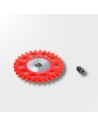
In a slot car, the pulley is the element that, in combination with a drive belt, transfers the rotational movement of the motor to the rear drive axle. Unlike the classic crown gear and pinion transmission —where the contact is direct between teeth— the pulley and belt system acts as a mechanical damper that smooths torque, reduces vibrations, and allows for some flexibility in the assembly.
This transmission system became particularly popular in inline (longitudinal, perpendicular to the rear axle) and anglewinder (motor at an angle to the rear axle) configurations, where the chassis geometry does not always allow for an efficient direct gear. Brands like NSR or Slot.it have developed very refined pulley transmission solutions, with very tight tolerances and materials that minimize energy loss.
Beyond the basic mechanical function, the pulley directly influences the final gear ratio of the car. By varying the diameter of the driving pulley or the driven pulley, we change the ratio between the RPM of the motor and the RPM of the rear axle, which translates into greater torque (acceleration) or higher top speed. In competition, this adjustment is made circuit by circuit, just like in the real motorsport world.
How to correctly choose pulleys
Choosing the right pulley is not just a matter of it fitting physically in the chassis. There are several variables we must consider before deciding:
- Diameter: This is the parameter that defines the gear ratio. A small driving pulley combined with a large driven pulley reduces the RPM at the axle but multiplies the torque. Conversely, a large driving pulley increases the top speed. Generally, circuits with many tight corners require more torque; fast layouts with long straights require more speed.
- Material: Technical plastic pulleys are lightweight and economical, suitable for recreational use or testing. Aluminium pulleys offer greater rigidity, better heat dissipation, and less deformation under load, making them the preferred option in competition.
- Compatibility with the belt: The width and profile of the pulley groove must match exactly with the type of belt we are going to use. Any misalignment, even if minimal, generates premature wear and loss of efficiency.
- Compatibility with the chassis and motor: Always check the measurements of the motor shaft and the rear axle, as well as the available space in the chassis. Not all pulleys are suitable for all setups.
- Target track system: Although the pulley itself does not depend on the rail system, the regulations of the championship in which you will compete may limit the materials, gear ratios, or even the type of transmission allowed.
Our recommendation: if you are starting with pulley transmission systems, opt for a complete kit from a recognized brand that includes a driving pulley, a driven pulley, and a belt. This way, you avoid compatibility issues from the outset.
Main types and differences
The catalog of pulleys for slot can be classified mainly by two criteria: material and diameter/gear ratio.
By material
- Technical plastic pulleys (nylon, POM, etc.): Lightweight, economical, and sufficient for recreational use. They may suffer deformation with heat or under high loads during long sessions.
- Anodized aluminium pulleys: The reference in competition. Greater rigidity, heat resistance, and dimensional precision. Brands like NSR or Slot.it manufacture them with jewellery tolerances.
By function in the system
- Driving pulley: Mounted directly on the motor shaft. Its diameter determines the output speed to the belt.
- Driven pulley: Mounted on the rear axle. Its diameter, in relation to the driving pulley, defines the final gear ratio.
By gear ratio
The combination of diameters generates different ratios. A low ratio (small driving pulley / large driven pulley) favours acceleration; a high ratio (large driving pulley / small driven pulley) favours top speed. The most common ranges in 1/32 slot competition oscillate between ratios of 2.5:1 and 4:1, although it depends on the motor and the circuit.
Technical aspects we need to know
To get the most out of a pulley transmission system, it is advisable to understand some technical concepts that go beyond simple assembly:
Alignment of the pulleys
This is probably the most critical factor. If the pulleys are not perfectly aligned in the same plane, the belt works at an angle, generates heat from friction, wears out prematurely, and may skip during the race. Always use alignment tools or at least a precision ruler to verify this before each session.
Belt tension
A belt that is too loose slips; too tight, it overloads the bearings of the motor and the rear axle. The correct tension allows for a small lateral movement but without excessive play. Each manufacturer specifies the optimal tension for their belts: always consult it.
Transmitted torque and mechanical losses
The pulley and belt system transmits very efficiently, but not at 100%. There is a minimal loss due to belt flexing and friction. In high-level competition, efforts are made to minimize these losses by choosing the highest quality belts and pulleys and keeping the system perfectly clean and adjusted.
Interaction with the motor and motorization
In an inline setup, the motor is perpendicular to the rear axle, and the pulley transmission is the natural solution. In an anglewinder, the angle of the motor introduces an additional variable in alignment that requires specific pulleys and supports designed for that geometry. In a classic sidewinder (motor parallel to the rear axle), the transmission is generally direct via crown gear and pinion, although there are hybrid configurations.
Practical tips for use, maintenance, and preparation
- Regular cleaning: The belt and pulleys accumulate lubricant residues, dust, and rubber particles from the tyres. Clean the system with a dry cloth or a specific cleaner after each long session.
- Visual inspection before each race: Check the belt for cracks, fraying, or deformations. A damaged belt can break during the race. The cost of a belt is minimal compared to that of a lost race.
- Do not lubricate the pulleys or the belt: Unlike bearings or crown gears, the pulley-belt system should not be lubricated. The lubricant causes the belt to slip and defeats the purpose of the transmission.
- Replace the belt preventively: Even if it appears to be in good condition visually, in serious competition it is advisable to change the belt after a certain number of sessions, before signs of wear appear.
- Bearings in good condition: Competition pulleys mount their own bearings. Ensure they spin smoothly, without roughness. A faulty bearing transmits vibration to the assembly and degrades performance.
- Document your setups: Note which combination of pulleys you use on each circuit and the results obtained. Over time, you will build a database of setups that will save you testing time.
Common mistakes we should avoid
- Mixing pulleys and belts from different brands without checking compatibility: Belt profiles are not universal. A belt designed for a specific system may seem to fit but work incorrectly, causing slipping or premature wear.
- Ignoring alignment: This is the most common and costly error in performance. Even if the car "works," a minimal misalignment results in a constant loss of efficiency and accelerated belt wear.
- Choosing the ratio solely for top speed: A car that is very fast on the straight but takes time to exit corners will lose lap time. The optimal ratio balances acceleration and speed according to the specific layout.
- Not checking the tightness of the pulleys on the shaft: A pulley that spins freely on the shaft instead of being fixed to it is a source of problems that remains invisible until the car fails during the race. Always check that it is properly secured, whether by Allen screw, retaining glue, or the system specified by the manufacturer.
- Lubricating the belt system: As mentioned, but worth repeating: lubricant and drive belts do not mix well. Reserve lubricant for bearings and shafts.
Recommendations for beginners and advanced users
If you are starting with pulley systems
The most sensible approach is to start with a complete kit from a reference brand —NSR and Slot.it offer well-documented kits— that includes a driving pulley, a driven pulley, and a compatible belt. This way, you eliminate variables from the beginning. Use the gear ratio recommended by the manufacturer for a motor with similar characteristics to yours and learn to assemble and align correctly before experimenting with alternative ratios.
Do not underestimate the importance of alignment. Spend time learning it well from the start: it will save you many headaches later.
If you already have experience in preparation
The field of experimentation with pulleys is broad: trying different materials, adjusting the ratio tenth by tenth for each circuit, combining pulley systems with different motors and chassis. High-precision aluminium pulleys are the reference when looking for the limit of performance.
Also consider the weight of the pulley as a variable: in competition cars where every tenth of a gram counts, a well-designed aluminium pulley can be lighter than its lower-quality technical plastic equivalent, without sacrificing rigidity.
For advanced users in regulated championships, always check the current regulations before adopting a new configuration: some regulations limit the materials or transmission ratios allowed.
| Type of pulley |
Material |
Recommended use |
Main advantage |
Disadvantage |
| Technical plastic (POM/nylon) |
Polymer |
Recreational / beginner |
Lightweight and economical |
Deformation under heat or high load |
| Anodized aluminium |
Aluminium |
Competition / serious preparation |
Rigidity, precision, durability |
Higher cost |
| Small driving pulley |
Indifferent |
Technical circuits, many corners |
More torque, better acceleration |
Lower top speed |
| Large driving pulley |
Indifferent |
Fast circuits, long straights |
Higher top speed |
Poorer acceleration response |
Frequently asked questions about pulleys
Are pulleys compatible with all slot chassis?
No. Compatibility depends on the type of motorization of the chassis (inline, anglewinder) and the measurements of the motor shaft and rear axle. Always check the manufacturer's specifications before purchasing.
Can I use a belt from any brand with my pulleys?
In general, it is not recommended. The profile of the pulley groove and the profile of the belt must match. Mixing brands without checking compatibility can cause slipping, premature wear, or even breakage of the belt during a race.
When should I change the drive belt?
Before visible cracks or fraying appear. In competition, it is common to make a preventive change after a certain number of sessions, even if the belt appears to be in good condition visually. It is a consumable part with a very low cost compared to the risk of breakage during a race.
Do aluminium pulleys really improve performance compared to plastic ones?
Yes, especially in prolonged use or under high demand. The greater rigidity of aluminium prevents deformations that can occur in plastic with motor heat. Additionally, the dimensional tolerances are tighter, resulting in a more efficient transmission.
How do I know what gear ratio I need?
It depends on the motor, the circuit, and the type of layout. As a starting point, use the ratio recommended by the manufacturer for a motor with similar characteristics. From there, adjust by testing: more torque for technical circuits, more speed for fast layouts.
Should I lubricate the pulleys?
The bearings of the pulleys do require specific lubrication for bearings. The groove of the pulley and the belt, on the other hand, should never be lubricated: the lubricant causes slipping and nullifies the transmission.
Do pulleys relate to the rail system (universal or sport)?
Not directly. The rail system (universal for Scalextric/Ninco, sport for Scaleauto/Slot.it) affects the guide and the distance between braids, but does not condition the internal transmission system of the car.
Which brands offer the best pulley systems for slot?
NSR and Slot.it are the most established references in pulley and belt systems for slot competition. Avant Slot and Scaleauto also offer quality solutions in their preparation ranges.
Is the pulley system better than the crown gear and pinion system?
It depends on the use. The pulley and belt transmission offers greater smoothness and reduces vibrations, making it ideal for inline or anglewinder configurations. The crown gear and pinion transmission is more direct and common in sidewinder setups. There is no universally superior solution: each has its optimal context.
Can I install pulleys on a car designed for crown gear and pinion?
In principle, no, unless the chassis has the necessary anchors and geometry. Some modular or competition chassis allow different transmission configurations, but this is a modification that requires technical knowledge and compatibility verification.
Does the weight of the pulley influence the car's behaviour?
In high-level competition, yes. Although the impact is less than that of the motor or tyres, reducing mass in rotating elements improves acceleration response. Well-designed aluminium pulleys can be lighter than lower-quality plastic ones, combining rigidity and reduced weight.
Where can I find more information about tuning with pulleys?
At Ministry of Hobby, we have the technical knowledge to advise you on selecting pulleys according to your motor, chassis, and type of competition. Do not hesitate to consult us before making a decision.