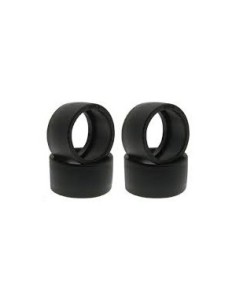
When we talk about tuning in slot racing, it is common for all the attention to focus on the rear tyres, motors, or guides. However, the front tyres play a much more relevant role than it seems at first glance. They are directly responsible for the front stability of the car, the transition on corner entry, and, to a large extent, how much support the chassis transmits to the front axle when the car is loaded in full trajectory. A poorly chosen set of front tyres can ruin a setup that, on paper, had everything necessary to perform well.
On track, the front tyres work differently from the rear ones: they are not responsible for transmitting traction, but they do influence how the car "enters" the corner, how it responds to the guide, and whether the front end tends to float or stay glued. This balance between the front and rear axles is one of the most interesting—and most underrated—adjustments in slot preparation.
Whether you are setting up a car for federated competition or fine-tuning your hobby setup to run at home with friends, understanding what differentiates one front tyre from another will save you many laps of trial and error. In this category, you will find the most commonly used front tyres by preparers and reference drivers, with technical information to help you choose wisely.
What are front tyres and why are they so important
In a slot car, the front axle has no traction or direct motor. Its function is to guide the car along the track, absorb directional changes, and maintain the overall stability of the assembly. The front tyres are the only point of contact of the front axle with the track surface, so their hardness, diameter, and width condition everything that happens on that axle.
A front tyre that is too soft can generate excessive grip at the front and hinder the car's rotation, causing it to "push" towards the outside of the corner (understeer). One that is too hard may cause the front end to lack sufficient support, making the car nervous and unpredictable. The correct balance depends on the combination with the rears, the type of track, the surface compound, and the chassis itself.
Unlike the rears, front tyres often seek a harder compound or a reduced profile to allow the car to rotate freely. This is one of the finest tuning decisions and also one of the most satisfying when done correctly.
How to correctly choose front tyres
Before selecting a set of front tyres, it is advisable to clarify these points:
- Size (diameter and width): each car has specific mounting tolerances determined by its chassis and body. It is essential to consult the recommended measurements by the manufacturer or check the available space in the front hub before purchasing.
- Compound (hardness): front tyres are more frequently mounted in medium or hard compounds than rears. On fast tracks with high loads in long corners, a slightly softer compound may be beneficial for stability; on technical tracks with many chicanes, a harder one favours rotation.
- Profile: low-profile tyres reduce the height of the centre of gravity and improve response, although they limit the natural damping provided by the rubber. Higher-profile tyres are more tolerant and are usually used in hobby cars or on uneven surfaces.
- Material: most competition front tyres are made of urethane rubber or synthetic blends of varying hardness. Some manufacturers also offer front tyres in silicone for very specific surfaces.
- Compatibility with the rim: the tyre must fit correctly on the front rim, whether plastic or aluminium. Poor adaptation causes deformations and imbalances that result in vibrations or erratic behaviour.
Brands such as NSR, Slot.it, Scaleauto, and Avant Slot offer catalogues of specific front tyres for their own models and also compatible with other chassis. Reviewing the technical data sheet of each reference is always the first step.
Main types and differences
Not all front tyres are the same. Beyond the measurements, there are important conceptual differences:
By compound
- Extra-soft / Soft: more grip, greater deformation under load. Rarely used on the front axle except in very specific low-grip configurations.
- Medium: the most common balance. Provides enough grip without penalising the car's rotation. Suitable for most surfaces and cars.
- Hard: less deformation, more direct response. Widely used in competition where precise and quick steering is desired. Favours turning on technical tracks.
By profile and shape
- Low profile: designed to maximise dynamic performance and lower the centre of gravity. More sensitive to track irregularities.
- Standard profile: greater tolerance, easier to use, suitable for hobby and for tracks with less uniform surfaces.
- Slick: treadless, smooth surface, maximum contact with the track. They are the norm in slot racing competition cars.
- With tread / knobby: found in rally or off-road cars. They provide visual realism, although their function on an indoor circuit track is more aesthetic.
By material
- Urethane: the most common in competition. Good wear resistance, controllable compound, easy to sand to adjust diameter.
- Silicone: greater grip on specific surfaces, more sensitive to temperature. Less common in front tyres.
- Standard synthetic rubber: the one fitted on standard cars. Suitable for recreational use, but with lower performance in competition.
Technical aspects we should know
To get the most out of front tyres, there are some technical concepts that are advisable to handle:
Diameter and its influence on behaviour
A front tyre with a larger diameter slightly raises the front end of the car and can modify the angle of the guide relative to the track, which directly affects contact with the rail and stability in chicanes. A smaller diameter lowers the front end, improves the aerodynamics of the assembly, and can favour support in long corners.
Width and contact patch
A wider tyre offers a larger contact surface and more lateral stability, but it can also generate more resistance to forward motion. In high-speed cars, reducing the width of the front tyre is a common strategy to minimise friction without sacrificing steering.
Sanding the tyre
In competition, it is common practice to sand the front tyres—just like the rears—to achieve a perfect and uniform diameter. A well-sanded front tyre rolls without vibration, improves response, and ensures that both wheels support equally. This is done with the wheel in motion over fine-grit sandpaper, checking the diameter with a micrometer or a specific tool.
Wheel balancing
Mounting the tyre correctly on the rim, centring it, and ensuring there is no eccentricity is essential to avoid vibrations. An unbalanced front tyre at high speed translates into instability and irregular wear that shortens the tyre's lifespan.
Practical tips for use, maintenance, and preparation
- Clean the front tyres before each session: dust and track debris accumulate on the tyres and reduce grip. A slightly damp cloth or a specific cleaner for slot tyres is sufficient.
- Check the diameter periodically: wear on front tyres is less than on rears, but it does exist. Ensuring that the diameter remains within the recommended margins avoids surprises in competition.
- Do not reuse deformed tyres: if a front tyre has suffered deformation due to heat or impact, it is safest to replace it. An oval tyre on the front axle immediately ruins the stability of the car.
- Store them correctly: keep front tyres away from heat sources and direct sunlight. Urethane and silicone can degrade with prolonged exposure to sunlight or extreme temperatures.
- Test different combinations with the rears: the performance of front tyres is always evaluated in relation to the rear axle. Changing only one axle without adjusting the other can lead to erroneous conclusions about the car's behaviour.
Common mistakes to avoid
Mounting the same front tyres always without adjustment
Many enthusiasts have "their" reference front tyre and mount it on all cars without considering whether it is the most suitable for each configuration. The ideal front tyre depends on the chassis, the rear it is mounted with, the type of track, and the surface compound. There is no perfect universal front tyre.
Ignoring the exact diameter
Mounting front tyres with a larger diameter than recommended can cause the body to rub against the tyre in tight corners, resulting in unintentional braking that destabilises the car. Always measure before mounting.
Confusing soft compound with better performance
In rears, a softer compound is usually associated with more grip. In fronts, this logic does not always apply. An excessively soft compound can cause the front end to "hook" too much and hinder the car's rotation, especially in tight corners.
Not cleaning before analysing behaviour
Dirty front tyres with rubber debris or track dust can cause the car to behave erratically, leading us to change parts that are functioning well. Always clean before drawing conclusions.
Mixing sizes between left and right
Although it may seem obvious, it sometimes happens: mounting two front tyres of different diameters causes the car to run slightly tilted, with more support on one side than the other. Always use a homogeneous pair.
Recommendations for beginners and advanced users
If you are just starting
The most sensible approach is to start with the original front tyres that the manufacturer mounts on the car or, if not available, from a medium compound reference in the recommended size. Before experimenting with hardness or profiles, ensure that the tyre is well mounted, centred, and clean. 80% of behaviour problems in front tyres can be resolved with good basic preparation, without needing to change anything.
Brands like NSR and Slot.it include specific front tyres for their models in their catalogues with clear mounting instructions, which greatly facilitates the first steps.
If you already have experience
The next level involves working on the combination of compounds between front and rear as a conscious tuning variable. Experimenting with front tyres of a harder compound than the rears is the usual starting point in competition. From there, fine-tuning the diameter through sanding, working on wheel balancing, and testing different widths according to the type of track are the steps that mark the difference between a correct setup and a truly fast one.
For advanced users, Scaleauto and Avant Slot offer very specific references with different compounds and sizes that allow for very fine customisation of behaviour.
| Compound |
Hardness |
Common use in front |
User profile |
| Extra-soft / Soft |
Very soft |
Very low grip tracks, specific configurations |
Advanced / Competition |
| Medium |
Medium |
General use, hobby and standard competition |
All levels |
| Hard |
Hard |
Technical tracks, high speed, maximum rotation |
Intermediate / Advanced |
Frequently asked questions about front tyres
Do front tyres wear out the same as rears?
No. Since they do not have traction, front tyres wear out much less than rears. However, they can deform due to heat, incorrect supports, or impacts, so it is advisable to check them periodically even if they do not show obvious wear.
Can I mount front tyres from one brand on a car from another brand?
Yes, as long as the size is compatible with the rim and hub of the car. What is important is to respect the recommended diameter and width; the brand of the tyre does not have to match that of the car.
What happens if the front tyres are larger than the rears?
In most configurations, this raises the front end of the car and can cause the guide to lose contact with the rail on undulating track sections. It is most common for front tyres to be slightly smaller than the rears or the same size, but never larger.
Is it necessary to sand the front tyres?
In hobby, it is not essential. In competition, it is advisable to ensure that the diameter is exact and uniform between the two wheels, which eliminates vibrations and improves consistency of behaviour.
What front compound works best with soft rear compounds?
Generally, if the rears are soft, it is recommended to go up at least one grade in the fronts (medium or even hard) so that the front does not generate too much grip and the car can rotate smoothly. The exact combination depends on the chassis and the track.
Do front tyres influence top speed?
Directly, very little. But indirectly, yes: a poorly chosen front tyre can cause understeer, which forces a greater speed reduction on corner entry and penalises lap times even if the motor and rears are perfectly adjusted.
How often should I change the front tyres?
It depends on usage. In hobby, they can last many sessions if kept clean and do not suffer deformations. In competition, some preparers change them every few races to ensure consistent behaviour.
Are the plastic front tyres that some standard cars mount valid for competition?
In general, no. The plastic front tyres on standard cars are designed to reduce costs and have much lower grip and consistency than those made of urethane or specific rubber. For any serious use, it is advisable to replace them with tyres made of suitable material.
Can I use any front tyre on Scalextric and Scaleauto tracks?
The tyre itself has no incompatibility with the type of track; what changes is the guide and the rail system. The front tyre only needs to roll correctly on the surface, so what is relevant is to choose the appropriate compound for the track material (plastic, wood, carpet…).
Which brands offer the best catalogue of front tyres for 1/32?
NSR, Slot.it, Scaleauto, and Avant Slot have the most complete catalogues with the highest technical specificity. Each covers both their own models and references compatible with other common chassis in 1/32.