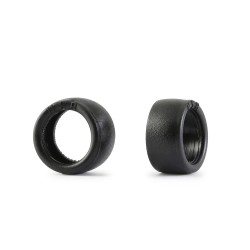
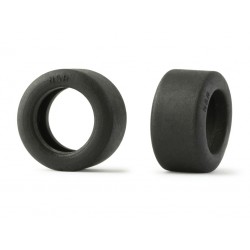
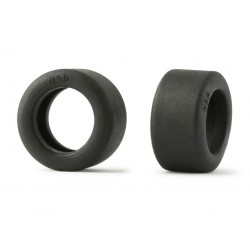
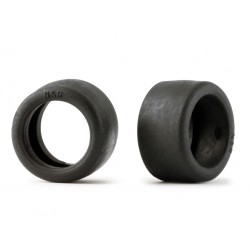
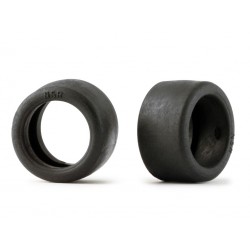
If you have been in the slot world for a while, you know that the motor, chassis, and electronics are fundamental, but all that engineering is useless if the rear tyre does not efficiently transfer the force to the ground. The rear axle is the point where power is converted into real speed —or wheel spin— and the tyre is the only element that mediates between the two. Therefore, choosing the right rear tyres is not a minor detail: it is one of the most influential decisions in the car's behaviour, both in informal runs and in timed competition.
Beginners often focus on motors and crown gears and leave the tyre until the end, almost as an accessory. Over time, most come to realise that a good pair of rear tyres makes more of a difference than many other upgrades. The contact patch with the track, the compound, the diameter, and the width determine the available grip, acceleration response, cornering stability, and even braking behaviour (in cars that have it modelled).
In this section, you will find rear tyres for the main scales and systems, from 1/32 competition cars to 1/24 setups, with different compounds —from harder rubbers for high-grip tracks to softer options that maximise contact— and in the most common sizes on the market. Whether you are preparing a car for a federated championship or looking to improve consistency in your weekend runs, here you have options to choose from wisely.
What are rear tyres and why are they so decisive
In a slot car, the rear axle is the drive axle: it is where the transmission from the motor arrives, through the pinion and crown gear. The rear tyre is, therefore, the only one responsible for converting that rotational energy into longitudinal movement on the track. There is no front-wheel drive, no torque distribution between axles: all the propulsion work falls on the two rear tyres.
This has direct consequences. A tyre that is too hard does not deform enough when contacting the track and reduces the actual contact surface; the result is a loss of grip during acceleration and a greater tendency to slide. One that is too soft can deform excessively at high speeds, heat up quickly, and lose consistency throughout the race. The balance between both extremes —and the correct adaptation to the type of track— is what makes the difference between a car that runs well and one that truly competes.
In addition to the hardness of the compound, the profile of the tyre (whether it is flat or rounded) influences how the car supports in corners: a flatter profile offers a larger contact surface on straights and slow corners; a more rounded profile reduces rolling resistance and favours quick entry into corners. These are nuances that more experienced drivers know and consciously exploit.
How to correctly choose rear tyres
Before buying, it is advisable to be clear about four factors that condition the choice:
- Compatibility with the rim: the tyre must fit the inner diameter and width of the rim mounted on the car. An incorrect tolerance causes the tyre to come off or be loose, resulting in vibrations and imbalances at high speed.
- Outer diameter: directly influences the effective gear ratio. A larger diameter effectively equates to a larger crown gear: the car gains top speed but loses acceleration. It must be calibrated along with the pinion-crown gear ratio.
- Width: greater width increases the contact patch and, in principle, the available grip. However, it also raises rolling resistance. On tracks with low grip or many long straights, sometimes a slightly narrower tyre offers better overall times.
- Compound: the designations vary by manufacturer, but generally, they are divided into hard, medium, and soft. The type of track (plastic, wood, cork, synthetic asphalt) and environmental conditions (temperature and humidity) should guide this choice.
A practical tip: when changing tyres, do not simultaneously modify other parameters of the car. This way, you can isolate the real effect of the tyre on the behaviour and adjust wisely.
Main types and differences
The market offers several types of rear tyres based on their composition and use:
Standard rubber
These are the most common in standard cars and medium-level setups. They offer predictable behaviour and a reasonable lifespan. They are usually the recommended option for beginners and informal runs.
Silicone
Silicone tyres have superior grip compared to conventional rubber and are very popular in competition. They can be sanded or turned more easily to adjust the diameter with millimetric precision. Their downside is that they accumulate dirt more quickly, requiring periodic cleaning during the session.
Urethane
Widely used in American competition cars and some club categories. They are extremely durable and offer consistent grip over many laps. Less common in European slot racing, but present in some specific setups.
Competition-specific tyres
Brands like NSR, Slot.it, or Scaleauto have references designed for their own cars and rims, optimised for the regulations of their categories. They usually come in different compounds within the same reference (identified by colours or letters) to adapt to different types of track.
Technical aspects we should know
To get the most out of rear tyres, there are some technical concepts that are advisable to handle:
Truing
This involves turning the tyre mounted on the car to ensure that both rears have exactly the same diameter and that the contact surface is perfectly cylindrical. It is one of the most common operations in competition preparation and significantly improves stability and traction equality between both sides.
Gluing the tyre to the rim
In competition, many drivers glue the tyre to the rim with a small amount of cyanoacrylate to prevent it from spinning on it under strong acceleration. It is a common practice but requires care: excess glue can harden the compound and reduce grip.
Operating temperature
As in real motorsport, silicone tyres and some competition compounds have an optimal temperature window. On cold tracks or in the early laps, grip may be lower; as the tyre heats up, it improves. This is a factor to consider in qualifying and at the start of heats.
Diameter-transmission ratio
As we have pointed out, the outer diameter of the tyre modifies the final transmission ratio. If you turn the tyres and reduce their diameter, you are effectively making the ratio shorter: the car will accelerate more but will lose some top speed. The crown-pinion ratio must be recalibrated or readjusted if the diameter change is significant.
Practical usage, maintenance, and preparation tips
- Regularly clean the tyres: especially silicone ones, which attract dust and debris from the track. A slightly damp microfiber cloth is sufficient between heats. Avoid aggressive products that may alter the compound.
- Store them away from light and heat: rubber and silicone compounds age with exposure to UV light and extreme temperatures. Keep them in closed bags or boxes, in a cool, dark place.
- Check the diameter before mounting: use a micrometer or caliper to verify that both tyres have the same diameter. A difference of tenths can be felt in driving as a slight constant drift to one side.
- Do not mix different compounds on the same axle: if you mount a soft tyre on one side and a hard one on the other, the car will tend to pull towards the side with less grip. Always work with a pair from the same batch if possible.
- True after each new mounting: although tyres come with specifications, it is always advisable to do a small truing to ensure concentricity with the axle.
Common mistakes to avoid
Over the years, we see the same mistakes repeating in the workshop. We tell you about them so you don't have to learn them the hard way:
- Choosing the tyre solely based on price: a cheap rear tyre incompatible with your rim or of an unsuitable compound for your track can ruin the entire setup. The price difference between options is usually small compared to the impact on performance.
- Not checking compatibility with the rim: not all tyres fit all rims. Always check the inner diameter of the tyre and the outer diameter of the rim before ordering.
- Mounting new tyres without truing: even the best competition tyres need a small adjustment. Mounting them directly without checking concentricity is one of the most common causes of vibration and erratic behaviour.
- Using non-regulatory treatments or additives: some enthusiasts apply products to soften the compound or artificially increase grip. In regulated competition, this can lead to disqualification; outside of it, it can damage the track or the tyre itself irreversibly.
- Forgetting the break-in: especially with silicone tyres, a few initial laps at a moderate pace allow the compound to reach its optimal temperature and the contact surface to settle properly.
Recommendations for beginners and advanced users
If you are starting
Start with standard rubber tyres compatible with the car you have. There is no need to invest in competition silicone until you have mastered other aspects of the setup. The most important thing at first is that the measurements are correct and that both tyres are well seated on the rim. A basic truing with fine sandpaper on a flat surface will already give you a noticeable improvement without the need for lathes or special tools.
If you already have experience
Explore the catalogues of NSR, Slot.it, and Scaleauto: each brand offers different compounds designed for their own cars and for different types of track. Keep a record of which combination of tyre, diameter, and compound you have used on each track and under what conditions: over time, you will have your own database that will save you a lot of adjustment time in competition. Truing with a lathe is an investment that pays off quickly if you race with some frequency.
| Material |
Grip |
Durability |
Maintenance |
Common Use |
| Standard rubber |
Medium |
High |
Low |
Informal runs, beginners |
| Silicone |
High |
Medium |
Medium (frequent cleaning) |
Competition, advanced preparation |
| Urethane |
Medium-high |
Very high |
Low |
Specific categories, long-lasting |
Frequently asked questions
Can I mount any rear tyre on my car?
No. You must verify that the inner diameter of the tyre matches the outer diameter of the rim, and that the width is compatible with the available space in the chassis. Each manufacturer specifies the measurements of their rims; consult those specifications before choosing.
What is the difference between a rubber tyre and a silicone tyre?
The silicone tyre offers greater grip on most tracks and can be trued more easily, but it accumulates dirt faster and requires regular cleaning. The rubber tyre is more resistant to dirt and has a longer lifespan, although its maximum grip is lower.
Is it necessary to true new tyres?
In competition, yes: truing ensures that both rears have exactly the same diameter and that the contact surface is perfectly uniform. In informal runs, it is not essential, but it always improves stability.
How does the diameter of the tyre affect the speed of the car?
A larger diameter increases top speed but reduces acceleration, as it modifies the final transmission ratio in the same way that changing to a larger crown gear would. It is a parameter that must be calibrated along with the crown-pinion combination.
How often should I change the rear tyres?
It depends on usage and compound. In competition, some drivers change them every few sessions; in informal runs, they can last many months. The clearest sign that they need to be changed is when grip noticeably decreases or when wear is uneven between the two sides.
Can I use the same tyres on wood track and plastic track?
Technically yes, but performance will vary. Wooden tracks usually require harder compounds because they have more base grip; on plastic tracks or those with less grip, softer compounds may yield better results. Ideally, have different references for each type of surface if you race on both regularly.
Are NSR rear tyres compatible with Slot.it cars?
It depends on the mounted rims. If the Slot.it car has rims with the same measurements as the NSR, the tyre may fit, but you should always check the inner diameter and width before mounting. There is no guaranteed universal compatibility between brands.
What happens if the two rear tyres have different diameters?
The car will tend to turn or drift towards the side with the smaller diameter tyre, as that side covers less distance per axle rotation. On track, this is felt as a constant tendency to veer to one side, especially on straights.
Is it advisable to glue the tyre to the rim?
In competition, it is a common practice to prevent the tyre from spinning on the rim under intense acceleration. A small amount of cyanoacrylate is used. Outside of competition, it is not necessary unless you notice the tyre slipping on the rim.
Do rear tyres also influence braking?
In slot cars without active brakes, braking occurs mainly through engine braking when releasing the trigger. The rear tyre influences the effectiveness of that engine braking: with more grip, deceleration is more progressive and controllable; with less grip, the car tends to slide under hard braking.