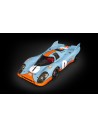
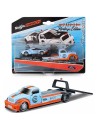
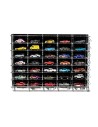
There are details that make the difference between a finished model and one that truly impresses. Decals are one of those details: a well-centred race number, a competition livery with all its sponsors in place, a registration plate with the exact registration, or the crest of a historical figure applied without bubbles or wrinkles. That final finish, which sometimes goes unnoticed by those who do not model, is the first thing detected by someone who does.
At Ministry of Hobby, we work with decals for the entire spectrum of modelling: slot cars in 1/32 and 1/24 scale, static models of cars, planes, motorcycles, and boats, historical and fantasy figures, and dioramas of all kinds. It doesn’t matter if you are finishing a Le Mans GT with the official decoration of a specific season or if you need the race numbers for a classic rally for a resin model: decals are an essential part of the process, and choosing them well makes a difference in the outcome.
This section groups references from specialised manufacturers, original decals from brands like Avant Slot, Scalextric, or Slot.it for their own vehicles, and generic sheets of sponsors, registration plates, signage, and decoration that work equally for a resin Porsche 917 as for a Napoleonic infantry figure. The aim is for you to find what you need without having to search in ten different places.
If you have been in modelling for a while, you already know that the quality of a decal is not only seen in the catalogue photo: it is seen when you immerse it in water, when you slide it over the surface, and when you apply the setting solution. A low-quality decal breaks, shifts, leaves a visible film edge, or loses colour when varnished. That’s why we care about what references we have in the catalogue, not just how many.
What are decals and why do they matter in modelling
A decal —also called decal in Anglo-Saxon terminology, a term very common in specialised forums and publications— is a thin sheet of plastic film onto which the decoration is printed. That film separates from the backing paper when moistened and is transferred to the surface of the model, where it adheres once dry.
Their function in modelling goes far beyond decoration. In competition —both in slot and static models— decals allow for the faithful reproduction of the official liveries of specific seasons: team colours, sponsors, race numbers, stripes, and bands that would be impossible to paint by hand with the same precision. In historical figures, they allow for the application of badges, heraldic crests, or military emblems with a level of detail that the finest brush cannot match. In dioramas, they provide authenticity to signs, traffic signals, commercial signage, and all the urban or military atmosphere surrounding the figures and vehicles.
A well-applied decal goes unnoticed: it integrates into the finish of the model as if it had always been there. A poorly applied decal —with raised edges, air bubbles, or visible film around the decoration— ruins hours of prior work. Hence, it is not a secondary material: it is a central element of the construction and painting process.
How to choose the right decals for your project
Before adding a sheet of decals to your cart, it is advisable to ask yourself some specific questions that will determine whether that reference is suitable for what you are working on.
Is it compatible with the scale of your model?
Decals are designed for specific scales. A sheet of race numbers intended for 1/32 will not work the same on a 1/24 model: the characters will be too small, and the overall proportion will look odd. Always check the scale indicated in the description of the sheet before purchasing. For slot in 1/32, models in 1/24, or figures in 54 mm, the sizes are very different and not interchangeable.
Are they water-slide decals or of another type?
The most common in modelling are water-slide decals (waterslide decals): they are immersed in warm water for a few seconds, slide off the backing paper, and are positioned on the already painted and varnished surface. They are the most used because they allow for fine adjustment before setting. There are also dry transfer decals (dry transfer), which are transferred by direct pressure without water, commonly used in some references of Formula 1 cars in 1/43 scale. Knowing the type is key to preparing the surface and the process correctly.
Is the surface prepared?
Applying a decal on unvarnished matte paint is one of the most common mistakes. The porous texture of matte paint traps microbubbles of air under the decal film and generates the silvering effect that ruins the finish. The solution is to first apply a layer of glossy or semi-gloss varnish that seals the surface and leaves it smooth. After the decal, the decal setting solution —like Micro Sol or equivalents— helps conform the film over textures, rivets, or raised panels.
Is it an original or generic decal?
Original brand decals (those that come with the slot car or model, or those sold by the manufacturer as replacements) reproduce the official decoration of the specific model. Generic sheets offer reusable elements: numbers from 0 to 9, letters, country flags, fuel or tyre logos, registration plates from different eras and countries. Both have their place: originals for restoring or completing a specific model, generics for personalising or creating custom liveries.
Main types and differences
The market for decals for modelling is broader than it seems at first glance. Here are the main types you will find in our catalogue:
- Full livery decals: reproduce the complete decoration of a real competition vehicle: base colours, stripes, sponsors, and numbers. They are the most sought after in slot and static model racing cars.
- Numbers and letters decals: sheets with sets of digits and characters in various styles, sizes, and colours. Essential for personalising race numbers, registration plates, or any inscription.
- Sponsor and logo decals: reproductions of real commercial brands that appear on competition cars: fuels, tyres, manufacturers, energy drinks. They allow for completing a livery that is missing some elements or building a custom decoration with a realistic appearance.
- Insignia and military emblem decals: crosses, stars, unit numbers, national flags, and regimental crests for military models and historical figures. They require a lot of precision in printing because the detail is minimal at scale.
- Signage and ambient decals: road signs, shop signs, traffic signals, commercial signage. They are the natural complement for dioramas of any era and setting.
- Instrumentation decals: dashboards, dials, indicators, and interior details for models of cars, planes, and military vehicles. They allow for a very convincing interior finish without the need to paint each instrument by hand.
Technical aspects we need to know
There are some technical variables that directly affect the quality of the final result and that it is advisable to understand before starting to work.
The backing and thickness of the film
Quality decals have a very thin film that integrates better onto the surface and reduces the visibility of the edge. Cheaper or older decals have thicker films that leave a perceptible step around the decoration. Subsequent varnishing (over the already dry decal) helps to unify that step, but the thinner the starting film, the better the final result will be.
The quality of the printing
A good decal has solid colours, precise registration (the colour layers fit without shifts), and truly opaque blacks. Opacity is especially important when the decal goes over dark backgrounds: a decal printed only in CMYK process may lose brightness over black or red. Higher quality references include a base white layer that guarantees colour fidelity regardless of the background.
Compatibility with varnishes and setting solutions
Not all varnishes are compatible with all decals. Solvent-based varnishes can attack the film if applied before the decal is completely dry or if applied with too much flow. Acrylic varnishes are safer in that regard but may take longer to achieve the desired finish. It is always advisable to do a test on a non-visible area or on a sacrificial decal before varnishing the entire piece.
Storage and preservation
Old decals become fragile and break when moistened. The backing paper can yellow, and adhesion decreases. To prolong the lifespan of a sheet of decals, it should be stored in a dry place, away from direct light and without temperature fluctuations. If you have old sheets that break, there is a decal softener or softening solution that can help regain some flexibility, although the result is not always perfect.
Practical application tips
The technique for applying decals has its steps and tricks. Following them in an orderly manner avoids most problems.
- Prepare the surface: apply a layer of glossy varnish over the paint before placing any decal. The surface must be smooth and free of porosity.
- Cut precisely: use a craft knife or fine-tipped scissors to trim each decal with the minimum of clear film possible around the motif. The less clear edge, the less risk of the outline being visible.
- Soak for the right amount of time: warm water, not hot. 15-30 seconds is enough for most decals. If you soak it too long, the film may detach from the backing by itself and be difficult to handle.
- Slide, don’t yank: place the decal with its backing paper on the surface in the approximate position and gently slide the paper out while the film stays in place. Don’t try to grab it with tweezers from the start.
- Position with a wet brush: a fine-tipped brush moistened in water allows you to move the decal precisely during the first few minutes before it starts to dry.
- Remove excess water: gently press with a cotton swab or a lint-free cloth to absorb the excess water. Do this from the centre towards the edges, without rubbing.
- Apply setting solution if there is relief: over textured surfaces, rivets, or raised panels, Micro Sol or equivalent softens the film and allows it to conform to the topography. Apply with a brush, do not touch the decal while it acts, and let it dry completely.
- Varnish over the top: once the decal is dry (at least 24 hours), apply a layer of varnish to integrate and protect it. Use the finish you want for the model: matte, satin, or glossy.
Common mistakes to avoid
Most problems with decals can be solved if anticipated. Here are the most common errors:
- Applying over unvarnished matte paint: generates the silvering effect (silvering around the decoration) due to microbubbles of air. Always apply glossy varnish beforehand.
- Soaking for too long: the film separates from the backing in the water and folds over itself. Difficult to recover without breaking it.
- Rubbing instead of pressing: scrubbing the newly placed decal shifts it, wrinkles it, or breaks it. Only gentle pressure and movements from the centre outwards.
- Not letting it dry before varnishing: varnishing over a wet decal can lift the film or cause the solvent to attack it. Patience: at least 24 hours.
- Ignoring the scale: using a decal of the wrong scale is an error that cannot be fixed once applied. Always check the scale before buying.
- Storing sheets in poor condition: humidity, heat, and direct light degrade decals even if you haven’t opened them. Store them properly from day one.
Recommendations for beginners and advanced users
If you are starting
The most important thing at the beginning is not to skip the prior varnishing step and to practice with simple decals —large numbers, simple shapes— before tackling a complex livery with many small elements. Get a bottle of decal setting solution from the start: it will save you more than once. Decals from static car models in 1/24 or 1/32 are a good starting point because they are a good size and easy to handle.
For the first slot projects in 1/32, the original decals from the manufacturer are the simplest option: they are already designed for that specific car and fit without the need for cutting or adjusting.
If you already have experience
At advanced levels, working with decals becomes a tool for customisation and scratch-building. Creating your own liveries by combining generic sheets of sponsors, numbers, and coloured backgrounds is a common practice among slot racing preparers. It is also possible to print custom decals with inkjet printers on white decal paper, although the opacity of whites and reds can be a challenge if a white layer is not included first.
For advanced figures and dioramas, signage decals in 1/35 or 1/48 scale allow for a level of ambience that no other technique matches in time invested vs. result. Combined with weathering techniques like chipping or washes, they integrate perfectly naturally into the final finish.
| Type of decal |
Main discipline |
Common scale |
Difficulty level |
| Full competition livery |
Slot, static model |
1/24, 1/32 |
Intermediate |
| Generic numbers and letters |
Slot, model, figures |
Various |
Beginner |
| Insignia and military emblems |
Figures, military model |
1/35, 1/48, 54 mm |
Intermediate-Advanced |
| Signage and ambience |
Dioramas |
1/35, 1/72 |
Beginner-Intermediate |
| Interior instrumentation |
Static model |
1/24, 1/32 |
Intermediate |
| Dry transfer decals |
Static F1 model |
1/43 |
Advanced |
Frequently asked questions about decals
What is the difference between a decal and a sticker?
A sticker has adhesive on the back and sticks directly. A water-slide decal has a film that separates from the backing when moistened and adheres to the surface by surface tension and subsequently by the varnish. The decal provides a much more integrated and realistic finish because the film is ultra-thin and does not have the relief of a sticker.
Can I apply decals directly onto matte paint?
It is not recommended. Matte paint has a porous texture that traps microbubbles under the decal and produces the silvering effect. Always apply a layer of glossy or semi-gloss varnish before placing the decals.
What varnish should I use over the decal?
You can use any varnish compatible with the base paint you have used. Acrylics are the safest to avoid attacking the film. The finish (matte, satin, glossy) is up to you depending on the result you want for the model. Always apply in thin layers and never soak the decal while still wet.
What should I do if the decal wrinkles or breaks when applying it?
If it wrinkles, re-moisten the area with a brush with water: the decal regains mobility, and you can reposition it. If it breaks, there is not much to do except try to fit the fragments together with patience. To avoid this, do not soak the decal longer than necessary and always handle the film while wet.
Can slot decals be used for static models and vice versa?
It depends on the scale. If the scale matches (for example, both in 1/32), the decals are perfectly interchangeable. The type of model (slot or static model) does not affect the application of the decal.
How do I recover an old decal that breaks?
You can try applying a decal softener to the sheet before cutting, letting it act for a few minutes, and proceeding with care. In some cases, it improves flexibility. If the film is very degraded, the most practical solution is to look for a replacement sheet.
Can I print my own decals at home?
Yes, with decal paper compatible with inkjet printers. The result is acceptable for logos and text on white or light backgrounds. For intense colours on dark backgrounds, you need paper with a white layer or to print in white first, something that only some specialised printers allow. It is a common technique among slot preparers who create exclusive liveries.
Are figure decals different from car decals?
The application process is the same, but the design is adapted to the discipline. Figure decals are usually smaller, with very fine detail elements (crests, insignias), while car decals prioritise solid colours and precise registration for competition liveries.
Do I always need decal setting solution (Micro Sol)?
Not always, but it is highly recommended when the surface has relief (panels, rivets, textures). On completely smooth surfaces, you can do without it, although a light application always improves adhesion and reduces the risk of edges lifting over time.
What is "silvering" and how is it avoided?
Silvering is the silver or whitish effect that appears around the motifs of the decal when microbubbles of air are trapped under the film. It is avoided by varnishing with gloss before applying the decal and using a softening solution to ensure that the film is completely in contact with the surface.
Are there specific decals for dioramas?
Yes. There are sheets specifically designed for dioramas: traffic signs by era and country, vintage advertising signs, shop signs, military information panels, registration plates from different nations and historical periods. They are a very effective resource for adding authenticity to the scene without the need to model or paint those elements from scratch.