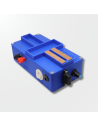
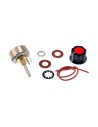
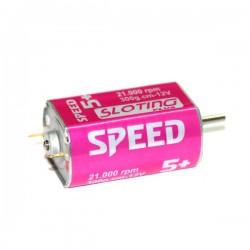
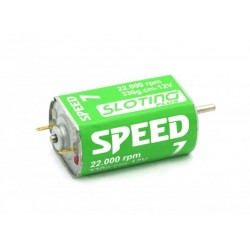
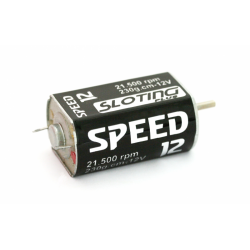
The motor is the component that most influences the behaviour of a slot car. It not only defines the top speed: it determines how it accelerates out of a slow corner, how much engine braking you recover when you lift the trigger, and whether the car is docile or twitchy at the limit. Choosing the right motor makes the difference between a car that is fun and one that is frustrating, both on wooden and plastic tracks, in training sessions as well as in timed races.
In this category, you will find direct current (DC) motors specifically designed for the slot world in scales 1/32 and 1/24: from balanced options for beginners to high-performance engines for serious competition. NSR, Slot.it, Scaleauto, and Avant Slot are some of the brands we work with, companies that understand preparation from the inside and publish real data on RPM, torque, and gauss so you can compare without guessing.
If you are looking to upgrade the stock motor of your car, install a new set on a bare chassis, or adjust the propulsion to a specific regulation, here you have the information and the necessary products to do so with guarantees. We explain what each specification means, which type of motor works best according to your setup, and what mistakes to avoid before spending money unnecessarily.
What is a slot motor and why does it matter so much
A slot motor is a miniature direct current (DC) electric motor that converts the electrical energy coming from the track —through the braids and the guide— into rotational motion. This motion is transmitted to the pinion, then to the crown gear, and finally to the rear axle, which turns the drive wheels.
Unlike what happens in other categories of modelling, in slot racing the motor operates under conditions of constant variable load: sudden starts, braking due to power cut, traction changes in every corner. That’s why slot motors are not generic electronic motors: they are designed to withstand repeated acceleration and braking cycles for hours, with high-density magnets and treated commutators to minimise wear on the braids.
The three magnitudes that summarise the behaviour of a motor are:
- RPM (revolutions per minute): rotational speed at nominal voltage. Higher RPM means higher top speed —as long as the gear ratio and tyre grip allow it.
- Torque: available turning force. A motor with high torque accelerates decisively and offers more engine braking when releasing the trigger.
- Gauss: intensity of the magnetic field of the magnets. It affects the magnetic grip of the car on the metal track and, indirectly, the stability in corners.
None of these three variables is better "by default": the key is to find the right balance for your track, your driving style, and the regulations you apply.
How to correctly choose a slot motor
Before buying a motor, it is advisable to answer four specific questions:
1. What size of can does your chassis accommodate?
The chassis of your car determines which can (short, long, or slim) you can mount. A Short Can does not fit where a Long Can goes, and a Slim Can is specific to narrow geometries. Always check the technical specifications of the chassis or consult the manufacturer's compatibility chart before ordering.
2. What motor configuration does your car have?
The position of the motor relative to the rear axle determines the type of pinion and the alignment of the assembly:
- Sidewinder: the motor is parallel to the rear axle (transverse). This is the most common configuration in GT and touring cars. The pinion meshes directly with the crown gear from the side.
- Inline: the motor is perpendicular to the rear axle, in line with the longitudinal axis of the car. It lowers the centre of gravity and improves mass balance. Very commonly used in prototypes and single-seaters.
- Anglewinder: the motor is placed at an angle relative to the rear axle. It combines advantages of the two previous configurations and allows for weight distribution adjustments.
Each configuration requires a specific type of pinion (straight or bevel), so the motor does not travel alone: it is essential to ensure that the rest of the drivetrain is compatible.
3. What is the appropriate power level for your use?
For training tracks or family use, a mid-range motor with moderate RPM and good torque is the smartest option: easier to drive, less wear, and more margin for learning. For competition on wooden tracks with regulated power supplies, high RPM motors with high-density magnets make a real difference in lap times.
4. Is there a regulation that limits the specifications?
Many clubs and championships set limits on gauss, torque, or even the specific model of motor allowed. Before investing in a competition motor, check the regulations of the series in which you will be racing.
Main types and differences
Slot motors are primarily classified by the size and shape of their metal can:
| Type of can |
Approx. dimensions |
Common use |
Examples of compatible chassis |
| Short Can (S-Can) |
Short can |
Rally, classic touring cars, training cars |
Standard Scalextric, Ninco |
| Long Can (Boxer) |
Long can |
GT, prototypes, high-performance competition |
NSR, Slot.it, Scaleauto |
| Slim Can |
Narrow can |
Formula 1, classic small-scale cars |
Specific F1 1/32 chassis |
Within each format, there are multiple variants depending on the number of poles of the magnet, the type of rotor core (stamped or solid), the number of magnets, and the treatment of the commutator. Not all "Short Can" motors are the same: internal differences can lead to variations of up to 30% in nominal RPM or notable differences in available torque.
Technical aspects we need to know
Operating voltage and power supply
Slot motors are designed to operate within specific voltage ranges, generally between 12 V and 15 V DC. Exceeding the maximum recommended voltage degrades the magnets, burns the winding, and drastically shortens the life of the commutator. Always use a regulated power supply adjusted to the motor's range.
The commutator and the braids
The commutator is the component that transmits electrical current to the rotating winding. With use, it accumulates oxide and carbon debris that increase electrical resistance and reduce performance. The motor's braids (different from the car's braids) are the flexible contacts that rub against the commutator: their condition is crucial for good current transmission.
Bearings vs. bushings
High-end motors use ball bearings at the ends of the shaft, which reduces internal friction and improves linear response. Entry-level or mid-range models typically use bushings (bronze or plastic sleeves), which are perfectly functional but require periodic lubrication and present slightly more friction.
The gear ratio
The motor does not work alone: the relationship between the pinion and the crown gear (number of teeth on each) multiplies or reduces the motor's RPM before reaching the wheel. A motor with high RPM and a long gear ratio may be slower on track than one with lower RPM and a shorter ratio. Fine-tuning the transmission is part of the preparation work.
Practical tips for use, maintenance, and preparation
Initial break-in
A new motor should run at low voltage for the first few minutes of use to allow the commutator and braids to settle properly. Running it at full power from the start significantly reduces its lifespan. The manufacturer usually indicates the recommended procedure; if not, 5-10 minutes at half the nominal voltage is a good general practice.
Cleaning the commutator
Use a specific cleaner for electric modelling motors, applied sparingly. Avoid generic degreasers, which can dissolve internal adhesives or attack the insulation of the winding. Cleaning every few race sessions extends the motor's life and maintains electrical response.
Lubrication
If the motor uses bushings, a minimal drop of modelling oil at each end of the shaft, on a regular basis, reduces wear. If it uses bearings, lubrication is less critical but still advisable in the long term. Do not exceed the amount: excess lubricant migrates to the commutator and ruins the electrical contact.
Checking the clearance and the pinion
A pinion mounted with excessive play or too much pressure on the crown gear generates noise, vibrations, and premature wear on both components. Always adjust the clearance (distance between pinion and crown gear) according to the manufacturer's recommendations for the chassis.
Common mistakes to avoid
- Buying based on RPM without considering torque: a motor with extremely high RPM but insufficient torque can be slower on track than a more balanced one, especially on circuits with many slow corners.
- Ignoring can compatibility: not all Long Cans have the exact same dimensions or the same mounting holes. Always check the technical specifications of the chassis and the motor before ordering.
- Confusing motor configuration: mounting a straight pinion in an anglewinder configuration or vice versa not only reduces performance but can also damage the crown gear.
- Not respecting the maximum voltage: scaling up the supply voltage to gain speed burns out the motor in just a few sessions. If you need more power, the right way is to change the motor, not to force the existing one.
- Neglecting the car's braids: a perfect motor with worn or dirty braids has poor electrical transmission. Performance is the sum of all components, not just the motor.
- Not checking the regulations before buying: in federated or club competition, a motor out of regulation is wasted money. Always check beforehand.
Recommendations for beginners and advanced users
If you are starting out
Opt for a mid-range motor, well documented by its manufacturer, with a moderate RPM level (between 20,000 and 25,000 RPM at 12 V) and balanced torque. Brands like NSR or Scaleauto publish detailed technical sheets that facilitate comparison. Avoid very high-power motors until you have mastered the rest of the setup: chassis, tyres, transmission, and driving technique. A very powerful motor in inexperienced hands is primarily a source of off-track incidents.
If you already have experience
The fine-tuning work starts here: adjust the gear ratio according to the specific layout of your track, experiment with different levels of gauss to balance magnetic grip and corner behaviour, and keep a record of lap times before and after each change to evaluate with real data. Slot.it and NSR motors for competition have variants with different windings that allow you to fine-tune the maximum power point according to the torque curve that interests you most.
In any case, the motor is just one piece of the system. The most cost-effective preparation work is almost always in the alignment of the assembly, cleaning of contacts, and correct choice of tyre and gear ratio before considering upgrading to a more expensive motor.
Frequently asked questions about slot motors
Can I mount any motor in my slot car?
No, not directly. The motor must be compatible with the can that the chassis accommodates (Short Can, Long Can, Slim Can), with the motor configuration (sidewinder, inline, anglewinder), and with the type of pinion available. Always check the technical specifications of the chassis before buying.
What is the difference between a 20,000 RPM motor and a 30,000 RPM motor?
The RPM determines the potential top speed, but the result on track also depends on the gear ratio, tyre grip, and layout. A 30,000 RPM motor is not necessarily faster on a technical circuit with many slow corners.
What are gauss in a slot motor?
Gauss measures the intensity of the magnetic field of the motor's magnets. A higher gauss value implies more magnetic grip on the metal rails of the track, which adds virtual load to the car and improves stability in corners, but also increases consumption and may alter behaviour on non-metal tracks.
Do slot motors require maintenance?
Yes. Periodic cleaning of the commutator, checking the condition of the motor's braids, lubricating the bushings (if applicable), and checking the pinion are the basic tasks to maintain performance and extend the motor's life.
Can I use a slot motor on a Scalextric track and on a Scaleauto track?
The motor itself is independent of the track system. What changes between systems (universal Scalextric/Ninco track versus sport track of Scaleauto/Slot.it) is the geometry of the chassis, the guide, and the spacing of the braids. If the chassis and the car are compatible with the track, the motor is not the limiting factor.
What happens if I mount a more powerful motor than the chassis manufacturer recommends?
The chassis may not be designed to absorb the extra torque, resulting in vibrations, deformations of the motor mount, and increased wear on the crown gear. Additionally, driving becomes much more demanding. Power must always be accompanied by a balanced setup.
Are there motors specifically for competition and others for recreational use?
Yes. Competition motors have tighter tolerances, higher quality materials (ball bearings, high-density magnets, treated commutators), and verified technical data. Recreational motors prioritise durability at low cost and ease of maintenance. For home use without timing aspirations, a mid-range motor is more than sufficient.
How often should I change the motor?
It depends on usage. A well-maintained motor in a moderate training environment can last many seasons. In intensive competition, wear on the commutator and internal braids eventually degrades performance; some drivers change the motor every season or after a certain number of track hours to ensure consistency.
Can I improve the original motor of my car without changing it entirely?
In some cases, yes: changing the magnets for higher gauss ones, replacing bushings with bearings, or polishing the commutator are possible modifications on certain models. That said, in most situations it is more practical and economical to replace the entire motor with a better one than to attempt to modify the original.
What brands of motors are most commonly used in competition?
NSR, Slot.it, and Scaleauto are the most common references in 1/32 competition. Each has its own families of motors with different power curves. The choice between them usually depends on the championship regulations and the chassis you use.
Does the sidewinder, inline, or anglewinder configuration affect which motor I can use?
It affects the type of pinion and the orientation of the motor within the chassis, but it does not limit the model of motor per se, as long as the can is compatible. What does change is the dynamic behaviour of the assembly: an inline setup lowers the centre of gravity compared to a sidewinder, which influences corner behaviour regardless of the chosen motor.
Can I use the same motor in a 1/32 car and in a 1/24 car?
1/24 cars typically use larger physical motors and more power than 1/32 cars, although there are can formats that are shared. Always check the specifications of the chassis and can: do not assume compatibility between scales without verifying it.