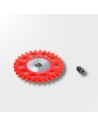
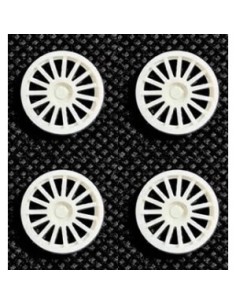
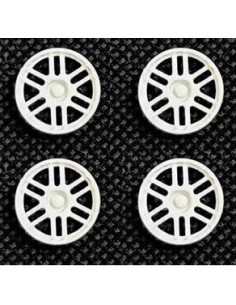
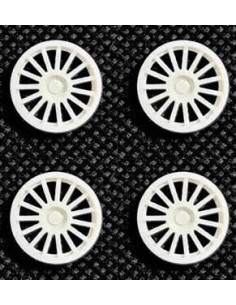
When a slot car is not performing well —vibrating, slipping, or not transmitting power as smoothly as expected— the first question any preparer should ask is whether the wheels are up to par with the rest of the setup. This component is much more than just the support for the tyre: it defines the rotational mass of the axle, affects the car's balance in corners, and determines whether the rubber works uniformly or shows uneven wear from the first practice session.
At Ministry of Hobby, we gather wheels for slot cars from the most demanding brands on the market —NSR, Slot.it, Avant Slot, Scaleauto— in materials, diameters, and widths designed for both serious competition and the preparation of a collector's car that also runs. If you are looking to reduce rotational inertia with lightweight aluminium, gain stiffness with magnesium, or simply replace a plastic wheel that has lost concentricity, you will find the correct reference here without the need to search through scattered catalogs.
This guide will help you understand which parameters really matter, how to choose the right material and size for your vehicle, what mistakes to avoid, and how to get the most out of well-chosen wheels. Whether you are preparing your first car or have been in the paddock for years, reading this before buying will save you time and some frustration on the track.
What are slot wheels and why do they influence performance so much
The wheel is the metal or plastic piece on which the tyre is mounted and which is fixed to the drive axle. Its function seems simple, but its impact on dynamics is enormous. A wheel with minimal concentricity imperfections —that is, whose centre is not perfectly aligned with the axis of rotation— generates vibration at high speeds, increases rolling resistance, and causes the tyre to wear unevenly, losing grip sooner than expected.
Moreover, the mass of the wheel is part of the so-called rotational mass: everything that rotates on the axle (wheel + tyre + axle itself) requires energy to accelerate and to brake. Reducing that rotational mass improves the car's response in acceleration and braking, which is critical on tracks with many chicanes or slow corners. That is why aluminium and magnesium wheels dominate competition: they weigh significantly less than technical plastic ones, although the latter remain a valid option for categories with material restrictions or for vehicles more oriented towards display.
Another decisive aspect is stiffness. A wheel that flexes under lateral load in a corner causes the tyre to deform unpredictably, generating understeer or oversteer depending on the affected axle. Alloy wheels are stiffer and maintain the tyre's geometry even with very soft silicone rubbers.
How to correctly choose wheels for your slot car
Before clicking "add to cart," it is advisable to have five parameters clear:
- Outer diameter: it must match the diameter of the original wheel or the size of the tyre you plan to mount. An incorrect diameter alters the height of the car, changes the effective gear ratio, and may cause rubbing with the bodywork.
- Width: the width of the wheel determines which tyres you can mount. A wheel that is too narrow does not hold the tyre well; one that is too wide may protrude from the wheel arches and generate rubbing with the bodywork.
- Axle diameter (bore): standard axles in 1/32 are 3/32" (2.38 mm). Some competition models use 2 mm or even 1/8". Always check this data before buying.
- Mounting system: most competition aluminium and magnesium wheels are fixed to the axle using M2 or M2.5 Allen screws, allowing them to be disassembled without damaging the axle and re-tightened accurately. Plastic wheels usually press-fit.
- Compatibility with the chassis and bodywork: not all wheels of nominally the same diameter have the same lateral displacement (offset) dimensions. An incorrect offset can place the tyre outside the wheel arch or too close to the chassis.
If you have doubts about compatibility with a specific model, the original part number from the car manufacturer is the most reliable starting point. Brands like NSR, Slot.it, or Scaleauto publish breakdown catalogs that specify exactly which wheel corresponds to each vehicle.
Main types and differences
Lightweight aluminium wheels
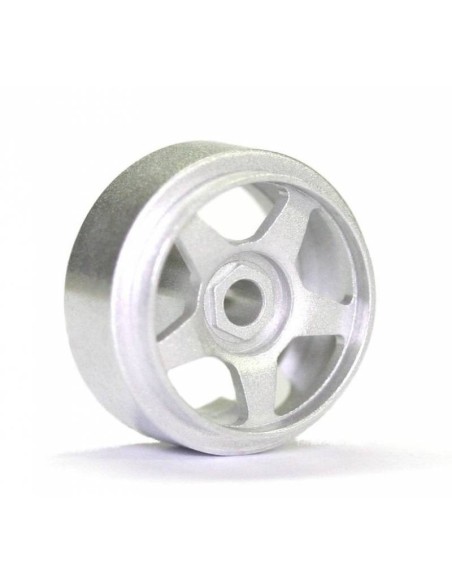
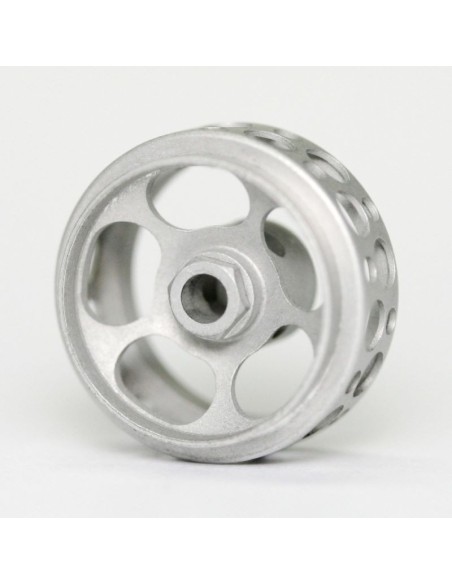
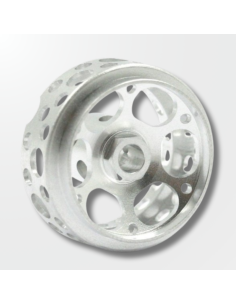
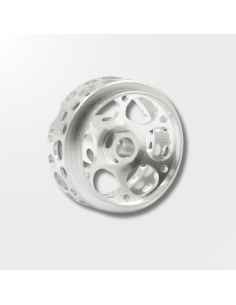
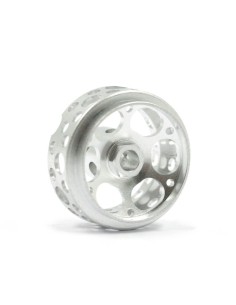
They are the de facto standard in 1/32 competition. Precision CNC machined aerospace aluminium offers excellent concentricity, low mass, and high stiffness. They are compatible with most silicone tyres on the market and allow for tyre profiling on the wheel (both the axle and the wheel itself act as machining references). NSR and Slot.it have a very wide catalog in this material, with offset and width variants for practically all their models.
Magnesium wheels
Magnesium is between 30% and 35% lighter than aluminium at the same volume, making it the most interesting material for minimising rotational mass. Its use is common in advanced competition categories. The main drawback is its greater fragility against impacts and its higher price. They are not the first choice for those learning or for very demanding tracks with many incidents.
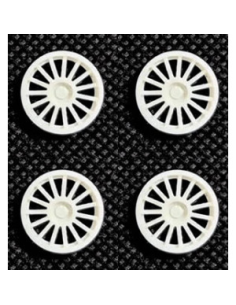
Technical plastic wheels
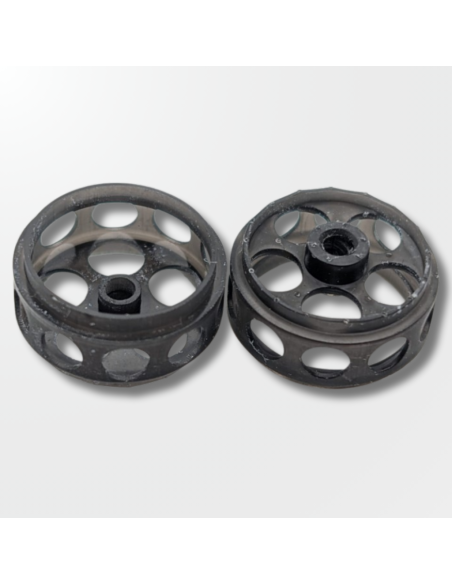
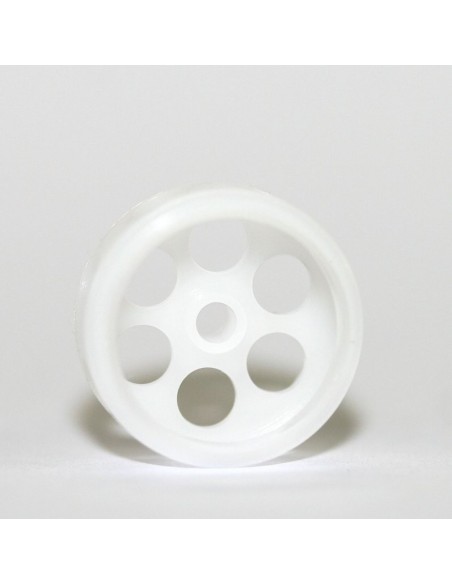
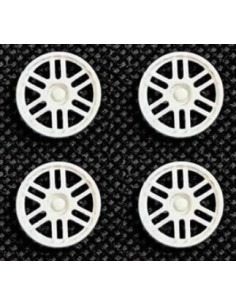
Present in most standard cars and many budget preparations. They are heavier than metal wheels but sufficiently precise for recreational use or for categories with material restrictions. Their main advantage is cost and ease of replacement. Avant Slot, for example, uses high-precision plastic wheels in some of its standard models that offer quite respectable performance before transitioning to the competition version.
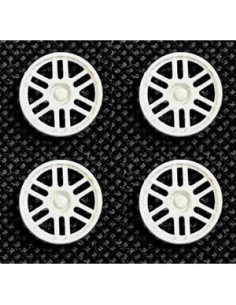
Wheels with hubcaps
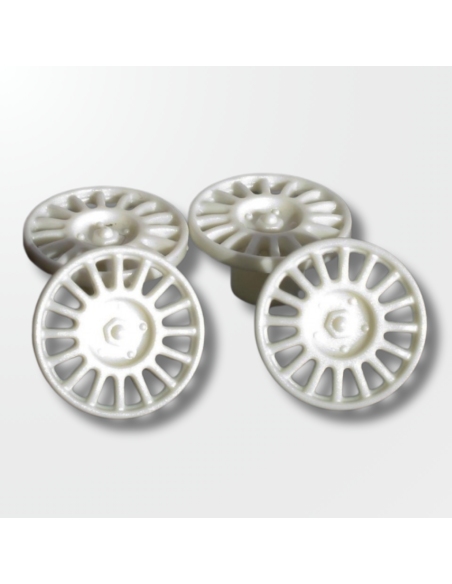
Some wheels incorporate decorative scale hubcaps that replicate the original design of the vehicle. They are more common in cars oriented towards collection or display, although they are also used in competitions that value visual fidelity. They are usually not the lightest, but they add a lot aesthetically.
Technical aspects we should know
Concentricity and runout
Concentricity is the measure of how the geometric centre of the wheel coincides with the axis of rotation. Runout is the maximum deviation measured at the outer edge. In competition, a runout of less than 0.02 mm is sought; above 0.05 mm, vibration is already perceptible. Quality CNC aluminium wheels typically guarantee values below 0.02 mm. Injected plastics can have runouts of up to 0.1 mm in low-quality specimens.
Relationship between wheel diameter and top speed
A larger wheel diameter, with the same crown/pinion ratio and motor speed, produces a higher top speed but reduces acceleration. A smaller diameter does the opposite. This is a tuning parameter that should be considered along with the gear ratio of the gear train.
Offset and tyre positioning
The offset determines how far from the centre of the axle the central plane of the tyre is located. A poorly chosen offset can cause the rubber to rub against the chassis, the frame, or the inside of the bodywork. Some manufacturers offer the same wheel with different offsets (inner, neutral, outer) precisely to fine-tune this parameter.
Compatibility between scales
1/32 wheels and 1/24 wheels are not interchangeable: the diameters, widths, and mounting systems are different. In 1/24, the axles are usually 1/8" and the wheels significantly larger. Always check the scale before ordering.
Practical tips for use, maintenance, and preparation
- Clean the axle before mounting: any residue of grease or dirt on the axle can prevent the Allen screw from tightening properly or the wheel from being centred. A little isopropyl alcohol on the axle before mounting makes a difference.
- Tighten with the appropriate torque: M2 Allen screws can be easily damaged if over-tightened. A firm but not forced tightening is sufficient; if the screw turns without gripping, check if the axle has wear marks.
- Profile the tyre with the wheel already mounted: if you are going to profile on the wheel, always mount the tyre on the wheel you will use in the race and profile the assembled unit on the working axle. Changing the wheel after profiling invalidates the work.
- Check concentricity after each disassembly: although aluminium wheels are robust, a strong impact can cause a slight deformation in the mounting area. A dial gauge on the workbench will confirm if the wheel is still valid.
- Store wheels without tyres: leaving the rubber mounted for a long time can slightly deform the tyre (especially in soft silicone) and also exert continuous tension on the wheel. If you are going to store the car for a season, remove the tyres.
Common mistakes to avoid
Buying by diameter without checking the bore
This is the most common mistake. Two wheels can have the same outer diameter but different axle diameters. A 3/32" wheel does not fit on a 2 mm axle without forcing it, and vice versa, it will be loose and vibrate. Always check the bore before buying.
Mixing wheels from different manufacturers on the same axle
Although two wheels may nominally be the same diameter, small differences in actual diameter from the manufacturer can cause the wheels on the same axle not to touch the track simultaneously, generating a traction imbalance that is difficult to diagnose.
Ignoring the offset when purchasing
Many enthusiasts buy the wheel "of the same diameter" as the original without verifying the offset. The result is a tyre that rubs against the bodywork or is excessively withdrawn, reducing the effective support base.
Over-tightening the Allen screw
Aluminium is soft, and M2 screws have low torque resistance. A stripped screw during a race means losing the wheel and possibly damaging the axle. Tighten carefully, and if the screw does not grip, check the condition of the axle.
Not profiling after changing the wheel
Mounting a new wheel (even of the same model) under a pre-profiled tyre requires re-profiling. The concentricity of the wheel+tyre assembly depends on the specific torque, not on the individual parts.
Recommendations for beginners and advanced users
If you are starting
It is not necessary to go straight to magnesium or the most expensive wheels in the catalog. A good lightweight aluminium wheel from NSR or Slot.it, in the correct diameter and width for your car, will make a very noticeable difference compared to the original plastic wheels without blowing your budget. Focus on choosing the right bore and diameter, and do not underestimate the importance of a good screw tightening.
For a first competition car in beginner categories, high-precision plastic wheels can be perfectly valid if the category regulations do not allow aluminium. Always check the regulations before buying.
If you already have track experience
Here the playing field expands considerably. Magnesium is worth it if you race in categories without material restrictions and seek maximum response in acceleration and braking. Pay attention to the offset for each specific body: a car prepared for competition usually has very tight margins in the wheel arches, and a poorly chosen offset can cost you tenths without you knowing why.
It is also worth exploring combinations of wheel diameter along with the crown/pinion ratio to fine-tune top speed according to the layout. A slightly larger wheel, combined with a pinion with one tooth less, can give you speed on the straight without sacrificing acceleration in slow corners. It is a subtle but very effective adjustment on mixed circuits.
| Material |
Relative Weight |
Concentricity |
Stiffness |
Relative Price |
Recommended Use |
| Technical Plastic |
High |
Medium |
Medium |
Low |
Standard, beginner, restricted categories |
| Lightweight Aluminium |
Medium |
High |
High |
Medium |
General competition, advanced preparation |
| Magnesium |
Low |
Very High |
High |
High |
High-level competition, maximum demand |
Frequently asked questions about slot wheels
What is the difference between an aluminium wheel and a magnesium wheel?
Magnesium is between 30% and 35% lighter than aluminium at the same volume. This reduces the rotational mass of the axle, improving response in acceleration and braking. However, magnesium is more expensive and somewhat more fragile against impacts. For regular competition use, aluminium offers a very good balance between performance, durability, and price.
Can I mount any wheel on my car?
No. You must check that the axle diameter (bore) matches that of your car, that the outer diameter and width are compatible with the tyre you want to mount, and that the offset does not cause rubbing with the bodywork or chassis. Checking the manufacturer's breakdown is the safest way to get it right.
What does "3/32" mean in wheels?
It is the diameter of the central hole of the wheel, which must match the diameter of the axle. 3/32" is approximately 2.38 mm and is the most common standard in 1/32 slot cars.
Is it necessary to re-profile the tyre when changing wheels?
Yes, always. Even if you mount the same model of wheel, each wheel+tyre pair has its own actual concentricity. Profiling on the assembled unit on the axle ensures that the rubber is perfectly round relative to the axis of rotation.
What screw is used to fix aluminium wheels?
The most common in 1/32 is the M2 or M2.5 Allen screw, depending on the manufacturer. NSR and Slot.it specify in their catalog which size each reference uses. It is advisable to always have a spare set, as they are small parts that are easily lost.
Do 1/32 wheels fit 1/24 cars?
No. The scales have completely different diameters, widths, and mounting systems. 1/24 wheels are significantly larger and usually use 1/8" axles. Always buy the specific wheel for the scale of your car.
How do I know if a wheel has lost concentricity after an impact?
The most reliable way is to use a dial gauge resting on the outer edge of the wheel while turning the axle by hand. A deviation greater than 0.05 mm is already perceptible in driving. If you do not have a gauge, a vibration that did not exist before or asymmetric tyre wear are clear signs.
What offset do I need for my car?
It depends on the model and bodywork. The correct offset is one that places the tyre within the wheel arch without rubbing against the bodywork or chassis. The manufacturer's catalog specifies which offset corresponds to each model, and at Ministry of Hobby, we can help you identify it if you have doubts.
Can I use aluminium wheels in a category with standard regulations?
It depends on the specific regulations. Many beginner categories require standard components or limit modifications to the running gear. Always check your championship regulations before investing in aluminium or magnesium wheels.
Does the diameter of the wheel affect top speed?
Yes. A larger diameter increases top speed but reduces acceleration, and vice versa. This parameter should be adjusted along with the crown/pinion ratio to find the optimal point according to the layout and motor characteristics.
Is it better to buy wheels with pre-mounted tyres or separately?
For competition, the ideal is to buy them separately and mount the tyre yourself, as you can choose exactly the rubber that best suits your track and preferences, and profile the assembly accurately. Wheels with pre-mounted rubber are more convenient for casual use or for quick replacements without entering into preparation.
What brands of wheels will I find at Ministry of Hobby?
We work with NSR, Slot.it, Avant Slot, and Scaleauto, among other references. They are the brands with the largest catalog of replacement and competition wheels for slot cars, with documented compatibilities and proven quality on tracks worldwide.