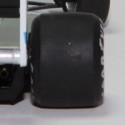
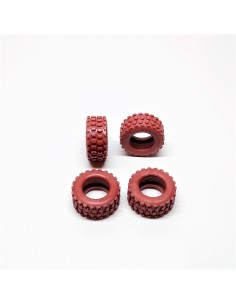
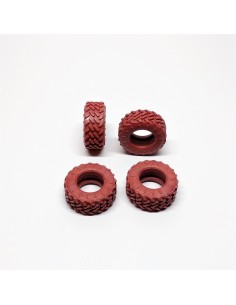
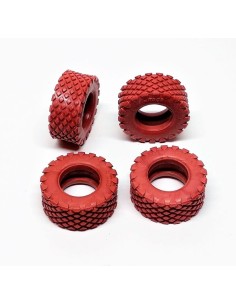
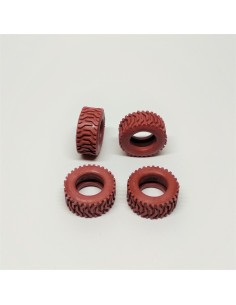
Few decisions influence the behaviour of a slot car as much as the choice of tyre. It's not just a matter of grip: the compound, hardness, profile, and size determine how the car reacts during braking, how it rotates in corners, how much chatter it generates on straights, and how long it lasts before degrading. It doesn't matter if you're preparing an NSR for wood competition or simply want your Scalextric home set to run more securely on plastic: the right tyre makes the difference between a car that is fun and one that is frustrating.
In this section, you will find tyres for both rear and front axles, in multiple compounds —natural rubber, silicone, polyurethane— and in a wide range of shore hardnesses, from the softest and most aggressive to the hardest and most durable. We cover common sizes for 1/32 and 1/24 chassis, compatible with the most widespread brands and platforms: NSR, Slot.it, Avant Slot, Scaleauto, and others. If you are looking for a specific tyre and can't find it at first glance, use the search function or contact us: the depth of our catalogue is one of our strengths.
This guide explains what differentiates each type of tyre, how to interpret the sizes and hardnesses you will see on each data sheet, what mistakes enthusiasts make when choosing (and how to avoid them), and when it makes sense to switch from a standard compound to a competition one. Whether you are just starting or have been preparing cars for years, you will find the information you need to make informed decisions here.
What is a slot tyre and why is it so important
The tyre of a slot car serves exactly the same function as in a real car: to transmit the driving force to the ground and allow the vehicle to follow a controlled trajectory. But in miniature, the tolerances are much tighter, and any variation in the compound or geometry has an immediate and clearly perceptible effect.
Unlike full-scale cars, where weight and aerodynamics contribute to grip, in slot racing the only element that "sticks" the car to the track is the tyre compound itself. Therefore, choosing the wrong compound can make a powerful motor unmanageable, while the right compound can partially compensate for mechanical deficiencies in the chassis.
The rear axle generates traction; the front axle conditions the steering and balance of the car. Both deserve attention, although typically the rear tyre receives more focus in tuning. If the front tyre has too much grip, it can induce understeer or increase resistance in corners; that's why many drivers opt for compounds with zero grip or very low profile on the front axle.
Another key factor is the track surface. The behaviour of a silicone compound on polished wood is radically different from that on injected plastic. Before choosing a tyre, it is essential to be clear about the type of track you will be running on.
How to choose the right tyre
The selection process may seem overwhelming at first —there are dozens of references, sizes, and hardnesses— but it simplifies greatly if you follow a logical order:
- Track type: plastic (Carrera, Scalextric, Ninco) or wood. On plastic, soft silicone compounds work very well; on wood, natural rubber and polyurethane usually yield more consistent and predictable results.
- Diameter and width: each chassis has specific rim dimensions and accommodation space. Check the measurements of your rim before ordering: the tyre should fit snugly, without radial play or lateral rubbing.
- Shore hardness: the lower the shore number, the softer and stickier the compound, but also more sensitive to heat and wear. A very soft shore on a hot plastic track can degrade in just a few sessions. A harder shore lasts longer in races, although it sacrifices some instant grip.
- Rear vs. front axle: for the rear, prioritise the compound that offers the best grip on your surface. For the front, consider a neutral or low-grip compound to avoid penalising manoeuvrability.
- Usage: home track, club, or regulated competition. In competition, the regulations usually specify the allowed tyre or limit the minimum hardness. Make sure to inform yourself before investing in a compound that you may not be able to use later.
A practical recommendation: start with a medium-soft compound, run several sessions, and evaluate the behaviour. Changing only the tyre —while keeping the rest of the setup the same— is the cleanest way to understand its real effect on the car.
Main types and differences
Not all tyres are the same or designed for the same purpose. Here are the main categories you will find in our catalogue:
Natural rubber
This is the most classic and widespread compound. It offers a good balance between grip and durability, with a progressive response that makes it versatile on both plastic and wood tracks. It is the usual starting point for enthusiasts looking for a neutral reference on which to build their setup.
Silicone
Very popular on plastic tracks. Silicone generates high grip from the first lap, without the need for prolonged warming up. Its Achilles' heel is its sensitivity to dirt: a silicone tyre easily "picks up" dust particles, which reduces its effectiveness if the track is not clean. However, on well-maintained tracks, the results are excellent.
Polyurethane
It stands out for its durability and consistency. It is the favourite in long-duration competitions and on wood tracks where stable behaviour is sought over many laps. It requires a bit more warming up than silicone, but once at temperature, it offers a very predictable response.
Low grip or zero grip front tyres
Specifically designed for the front axle, their goal is to minimise rolling resistance and improve cornering. They are usually low-profile and made of hard or semi-rigid compounds. In competition setups, where every millisecond counts, this type of front tyre is practically standard.
Foam tyres
Less common but present in some competition categories, especially in 1/24. They offer very high grip and a wide contact patch, although their lifespan is shorter and they require specific maintenance.
Technical aspects we should know
To get the most out of your choice, it is advisable to familiarise yourself with some technical concepts:
Shore hardness (Shore A)
This is the standard measure of hardness for elastomers. In slot racing, typical values range from 20 to 80 shore A. Below 35-40, we are talking about soft compounds; above 55-60, hard compounds. The ideal value depends on the track temperature, motor power, and running conditions.
Tyre measurements
Product sheets usually indicate the outer diameter, width, and inner diameter (which should match the outer diameter of the rim). Pay special attention to the inner diameter: a tyre that is too large will slip on the rim; one that is too small may deform the compound and generate vibrations.
Chatter or bounce
This is the vibration experienced by the car —especially on fast straights— when the tyre "bounces" on the track instead of rolling continuously. It usually appears with rear tyres that are too hard, poorly balanced rims, or excessively high spring pressure. A softer compound or a correctly trued tyre usually resolves the issue.
Tyre truing
This involves turning the tyre on the rim itself to ensure that the diameter is perfectly uniform around its circumference. A tyre that has not been trued can have tenths of a millimetre difference between points, causing vibrations and irregular behaviour. For competition, truing is practically mandatory.
Impregnation or grip treatment
Some drivers apply additives to the tyres to temporarily increase grip. This practice is allowed in some formats and prohibited in others; always check your championship regulations before using them.
Practical tips for use, maintenance, and preparation
- Always mount the tyre on a clean, grease-free rim. Any residue of lubricant on the rim will reduce the compound's adhesion and may cause the tyre to spin on the rim instead of rolling with it.
- True before running. Even if the tyre appears perfectly round at first glance, variations of tenths of a millimetre are enough to generate vibration. If you do not have a truing lathe, there are specific accessories to do it with the car's own motor.
- Clean silicone tyres frequently. A cloth slightly dampened with distilled water is enough to remove accumulated dust and restore the original grip.
- Store tyres away from direct light and heat. Rubber and silicone compounds age and harden over time if exposed to extreme temperatures or UV radiation. A closed drawer or an opaque zip bag is the simplest solution.
- Change rear tyres more frequently than front ones. The rear axle bears the entire load of traction; its wear is significantly greater. Don't wait until the tyre is visibly worn: a loss of diameter of tenths already affects performance.
- Do not mix tyres of different compounds on the rear axle. The two rear wheels must be identical to ensure balanced traction. Even differences in shore hardness between the same model can lead to asymmetric behaviour.
Common mistakes we should avoid
Choosing the tyre based on price, not on compound
A more expensive tyre is not always better for your combination of track, motor, and chassis. Similarly, an economical one can be the perfect option if the compound fits your surface. Always analyse the specifications before deciding based on price.
Ignoring rim measurements
This is the most common mistake among beginners. Ordering a tyre without checking the diameter and width of the rim often results in a useless component. Always have your rim measurements handy when placing an order.
Using the same compound on the rear and front axles
Unless in very specific configurations, mounting the same tyre on all four axles usually harms the overall behaviour of the car. The front axle has different needs: prioritise smoothness in corners over grip.
Forgetting to true
Even drivers with some experience often skip this step on home tracks, thinking it is not worth it. Truing eliminates chatter and significantly improves straight-line response. If you run with an untrued tyre, you are not seeing the real performance of the compound.
Not cleaning the track before running with silicone
Silicone compounds are very sensitive to dirt. A track with dust or lubricant residues will turn a high-grip tyre into a completely ineffective one in just a few laps.
Recommendations for beginners and advanced users
If you are starting out
The most important thing is not to complicate matters. Choose a natural rubber tyre with medium hardness (between 40 and 55 shore), of the diameter indicated by the manufacturer of your chassis or car, and run with it for several sessions before changing it. This way, you will learn to "read" the car's behaviour with a neutral reference. Brands like NSR or Slot.it offer well-documented tyres with clear specifications: they are a good starting point.
On the front axle, a low-profile tyre with high hardness usually works well in almost any beginner configuration. Don't complicate yourself with specific compounds for the front until you have the rear setup clear.
If you already have experience
It's time to fine-tune. Try different hardnesses on your usual track and note the results: lap time, chatter sensation, degradation after 10-15 minutes of running. A setup diary is a very valuable tool that few enthusiasts use systematically.
If you compete, inform yourself about the tyre regulations of your championship before investing in a specific reference. Many categories limit the compound or minimum hardness to level the playing field. In competition, precise truing and uniformity between the two rear tyres make more difference than the compound itself.
For users of wood tracks, polyurethane in medium-hardness is usually the most balanced choice in the long term. For plastic with a lot of natural grip, soft silicone can give you the advantage you are looking for, as long as you keep the track clean.
| Compound |
Grip |
Durability |
Ideal surface |
Sensitivity to dust |
| Natural rubber |
Medium |
High |
Plastic / Wood |
Low |
| Silicone |
High |
Medium |
Plastic |
High |
| Polyurethane |
Medium-High |
Very high |
Wood |
Low |
| Foam |
Very high |
Low |
Wood / Competition |
Medium |
| Zero grip (front) |
Minimum |
Very high |
Universal |
Very low |
Frequently asked questions
What does the shore number mean on a slot tyre?
Shore A measures the hardness of the compound: the lower the number, the softer and stickier it is, but also more susceptible to wear and heat. A high shore offers greater durability at the cost of some grip. Typical values in slot racing range from 20 to 80 shore A.
Can I use the same tyre on the rear and front axles?
Technically yes, but it is not usually the optimal choice. The front axle does not generate traction, so a low-grip compound reduces resistance in corners and improves manoeuvrability. Using a very sticky compound on the front can cause understeer or unpredictable behaviour.
How do I know what tyre size I need?
You need to know the outer diameter of your rim (the inner of the tyre should fit that value), the width of the rim, and the space available in the wheel arch. The technical sheet of the car or chassis usually indicates the recommended tyre size. If in doubt, contact us with the car or chassis model, and we will guide you.
Is it necessary to true the tyres?
For home track use and casual running, it is not strictly mandatory. For competition, or if you notice vibration and chatter on straights, truing is highly recommended. It ensures a uniform diameter around the circumference, eliminating vibrations and improving the car's response.
What tyre works best on Scalextric plastic track?
In general, soft silicone compounds perform very well on plastic, as long as the track is clean. If the track frequently accumulates dust, natural rubber in medium shore may be more consistent throughout the session.
What compound is best for wood track?
Polyurethane is the most popular on wood for its durability and progressive behaviour. Natural rubber also works well. Silicone can be too aggressive on very grippy wood and degrade quickly.
How often should I change the rear tyres?
It depends on the intensity of use and the compound. As a reference, in frequent competition sessions, it may be necessary to change them every few races. On a home track with moderate use, they can last for months. If the car loses traction or its behaviour changes without apparent cause, check the condition and diameter of the rear tyres.
Can I use grip treatments or additives on the tyres?
Some liquid additives temporarily increase the grip of the compound. Their use is allowed in certain competition formats and prohibited in others. Always check your championship regulations before applying them. In free running, they can be useful for testing configurations on low-grip tracks.
Do slot tyres have an expiration date?
They do not have an official expiration date, but rubber and silicone compounds age. If they have been stored for a long time —especially in heat or light conditions— they can harden and lose their properties. If a new tyre feels strangely stiff or cracks when stretched, it has probably aged poorly.
Are there differences in tyres between 1/32 and 1/24 scale?
Yes, and they are significant. 1/24 scale cars are larger and heavier, so their tyres have different dimensions. Additionally, 1/24 scale has its own tradition in competition with foam compounds that are hardly used in 1/32. They are not interchangeable between scales.
What front tyre do you recommend for competition?
Most competition drivers opt for low-profile front tyres with high hardness, or directly zero grip. The goal is for the front wheels to roll with the minimum resistance possible without providing grip, allowing the rear axle to manage all traction and dynamic behaviour.
Can I mount tyres from one brand on rims from another?
Yes, as long as the measurements match. The slot spare parts market operates with relatively standardised measurements, and it is common to combine, for example, Slot.it rims with NSR or Scaleauto tyres. The important thing is that the inner diameter of the tyre fits the outer diameter of the rim and that the width is compatible with the available space in the chassis.