There are components that go unnoticed until something fails, and the axle is one of them. When a slot car does not roll smoothly, vibrates at high speed, or the wheels do not spin concentrically, the cause is usually that small metal cylinder that runs through the chassis from side to side. Choosing the right axle is not a minor detail: it is the foundation on which the wheels rotate, the bearings work, and the power from the motor is transmitted to the ground.
In this category, you will find precision ground steel axles and carbon fibre axles designed for slot cars in 1/32 and 1/24 scale, from recreational use to the most demanding competition. The references we handle cover the standard diameters in the market and are manufactured with very tight tolerances, because in this component, a few microns of deviation are clearly noticeable in the car's behaviour.
Whether you are building a chassis from scratch, replacing a bent axle after an accident, or looking to reduce grams in a competition setup, here you have what you need. Leading brands such as NSR, Slot.it, Scaleauto, and Avant Slot offer specific catalogues for their chassis, although many axles are interchangeable between platforms if they respect the correct diameter and length.
What is the axle and why is it so important in slot racing
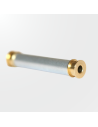
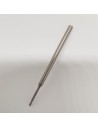
The axle is a precision cylinder —generally made of ground steel or carbon fibre— that runs transversely through the chassis and serves as a support for the wheels and the pinion or crown gear. Its function seems simple, but the technical demands are considerable: it must be perfectly straight, with a uniform diameter along its entire length and a surface polished enough to minimise friction with the bearings.
In a car that spins at thousands of rpm, any minimal eccentricity of the axle is amplified in the wheels and generates vibration. This vibration reduces the contact of the tyres with the track, causes loss of traction, and can even affect the guide and the braids. In other words: a defective axle contaminates the performance of the entire running gear.
Moreover, the axle is the dimensional reference point of the rear end: the track width depends on how the axle is positioned in the supports, and the height of the centre of gravity is influenced by the diameter of the wheels mounted on it. It is not a component that is chosen at random.
How to correctly choose the axle for your slot car
Before purchasing, there are three parameters you must know for sure:
- Diameter: the most widespread standard in 1/32 competition is 3/32" (approximately 2.38 mm). In 1/24 scale or in some advanced competition chassis, diameters of 1/8" (3.17 mm) or even metric sizes like 2.5 mm are also used. Always check your chassis manual or the manufacturer's specifications.
- Length: is determined by the width of the chassis and the distance between supports (bearings). Using an axle that is too short leaves the wheels without sufficient support; one that is too long can interfere with the bodywork or prevent centring.
- Material: ground steel is the predominant option due to its durability and price. Carbon reduces weight but requires more care in assembly to avoid splintering the ends. You must weigh which factor is more important depending on the type of use.
Beyond these three factors, also pay attention to whether the axle is solid or hollow. Hollow axles shave off grams that, although they may seem insignificant, add up to other weight reductions in the assembly. In regulated weight competition, this can be relevant.
Main types and differences
Ground steel axles
They are the de facto standard. They are manufactured from high-strength steel rod that is ground —that is, machined with an abrasive wheel— to achieve tolerances of ±0.01 mm or even less. The resulting surface is very smooth and allows ball or plastic bearings to slide with minimal friction. They are robust, resistant to bending, and relatively inexpensive. Their only drawback is the weight compared to alternatives.
Carbon fibre axles
Made from high-modulus carbon tube, they offer a notable weight reduction compared to steel. They are rigid but more fragile against lateral impacts and require more careful adjustment in the supports to avoid creating pressure points that could damage them. They are the choice of drivers competing in weight-restricted categories or looking to push their setup to the limit.
Solid vs. hollow axles
Solid axles are more robust and easier to handle. Hollow axles (both in steel and carbon) lighten the assembly and, by reducing the rotating mass, can slightly improve acceleration response. The choice between one and the other depends on the regulations of the category in which you compete and the priority you give to weight versus durability.
Technical aspects we need to know
The concept of concentricity is key: a concentric axle ensures that the wheels are mounted perfectly perpendicular to the car's longitudinal axis and that the radius of each wheel is identical throughout its rotation. If the axle is not perfectly straight, the car "jumps" at high speed instead of rolling smoothly.
The surface hardness of the steel also matters. Hardened steel better resists the marks left by the wheel and pinion fixing screws. If the material is soft, over time the screw creates a notch that misaligns the fixed element.
Regarding the relationship with the bearings, the fit must be precise: too much play generates lateral vibration; too much interference can prevent free rotation or damage the bearing. The ideal fit is the so-called "slip fit": the axle enters without pressure but without perceptible play.
Finally, keep in mind that the surface treatment of the axle influences its lifespan. The best steel axles come with a mirror polish or an anti-rust treatment that protects them from the humid environment typical of racing venues.
Practical tips for use, maintenance, and preparation
- Check for straightness before mounting: roll the axle on a flat glass surface. If it traces a perfect line without "dancing," it is straight. If not, discard it; it is not worth mounting a bent axle.
- Lubricate the bearings, not the axle: apply a micro-drop of silicone oil on the bearing, not directly on the axle. Excess lubricant on the axle can migrate to the tyres and reduce traction.
- Secure the components carefully: when tightening the wheel or crown retaining screws, do so with the right torque. An excessively tightened screw deforms the axle; a loose one allows the wheel to shift laterally under load.
- Inspect the axle after each strong impact: a violent off-track incident can slightly bend the axle. Even if it is not visible to the naked eye, the rolling test on glass will detect it.
- Store the axles protected from moisture: in a case or sealed bag. Surface rust, although fine, increases friction with the bearings and ruins the polished finish.
Common mistakes to avoid
Mounting the axle without checking the exact length. Cutting an axle to the correct length is common, but doing so without a square and with inadequate tools generates non-perpendicular ends that prevent proper seating in the supports.
Confusing diameter in inches and millimetres. An axle of 2.38 mm (3/32") and one of 2.5 mm may look similar, but the difference is enough for the bearing to be loose or for the axle not to fit in the support. Always measure with calipers before buying if you have doubts.
Reusing a bent axle after straightening it. It may seem straight, but the metal has memory, and internal micro-stresses generate vibration. A new axle costs little; the time lost adjusting a car that does not roll smoothly is priceless.
Ignoring the quality of the axle in an expensive setup. It makes little sense to invest in a motor, tyres, and tuned suspension if the axle does not have the necessary straightness or concentricity. It is the cheapest component in the drivetrain and one of the most critical.
Recommendations for beginners and advanced users
If you are just starting
It is likely that your first slot car comes with its factory axle in good condition. There is no need to change it unless you have had a notable accident or notice vibration at high speed that does not disappear with other adjustments. When the time comes to replace it, opt for a solid ground steel axle in 3/32" from a recognised brand like NSR or Slot.it: they are easy to find, have good tolerances, and can handle the pace of a learning driver without issues.
Always keep a couple of spare axles in your toolkit. They are small, weigh nothing, and solve problems in any race session without having to wait for an order.
If you already have experience and prepare cars for competition
At this level, it starts to make sense to explore carbon axles for weight-restricted categories, and hollow steel axles to lighten without sacrificing rigidity. Invest in a precision caliper (0.001 mm resolution) and measure each axle before mounting it: not all axles from the same batch are identical, and in competition, that tenth of a millimetre can make a difference.
It is also worth working on the axle fit in the supports with care: a misaligned support transmits lateral load to the axle and wears it unevenly. Adjust the geometry of the rear end on a flat reference table before putting the car on the track.
| Type of axle |
Material |
Relative weight |
Durability |
Recommended profile |
| Solid ground steel |
Hardened steel |
High |
Very high |
All levels |
| Hollow ground steel |
Hardened steel |
Medium |
High |
Intermediate / competition |
| Solid carbon |
Carbon fibre |
Low |
Medium (fragile to impact) |
Advanced competition |
| Hollow carbon |
Carbon fibre |
Very low |
Medium-low |
Regulated weight competition |
Frequently asked questions about slot axles
What axle diameter do I need for my 1/32 car?
The most common diameter in 1/32 competition cars is 3/32" (2.38 mm). It is the standard for brands like NSR, Slot.it, Scaleauto, and Avant Slot. Check your chassis specifications to confirm, as some models use their own metrics.
Can I use a steel axle in a chassis designed for carbon?
If the diameter and length match, yes. The material itself does not affect mechanical compatibility. What changes is the weight and, in some cases, the fit with the bearings if the tolerances of the carbon axle were slightly different.
How do I know if an axle is bent?
The most reliable method is to roll it on a perfectly flat glass or marble surface. If the axle "dances" or lifts at any end, it is bent. You can also hold it between two bearings and spin it, observing if there is visible wobble.
How often should I change the axle?
There is no fixed interval. Change it when you notice vibration that wasn't there before, after a strong impact, or if the caliper reveals it has lost roundness or straightness. In recreational use, it can last for years; in intense competition, it is advisable to check it every few sessions.
Are hollow axles less durable?
It depends on the material and wall thickness. A good quality hollow steel axle can easily withstand the loads of a 1/32 slot car. Fragility is more of a factor to consider in carbon axles, which are more sensitive to lateral impacts.
Is there a difference between axles from different brands with the same nominal diameter?
Yes, and it is significant. The quality of the grinding, the hardness of the steel, and the actual tolerances vary between manufacturers. An axle from NSR or Slot.it has stricter dimensional control than many generic options. For recreational use, the difference may be imperceptible; for competition, it matters.
Can I cut a long axle to fit my chassis?
Yes, but do it with a pipe cutter or a suitable cutting tool to achieve a clean perpendicular cut. Lightly sand the cut end to remove burrs. An irregular cut can prevent proper seating in the supports.
Does the axle influence the geometry of the car?
Directly. The length of the axle determines the track width, which affects stability in corners. A laterally misaligned axle alters weight distribution and can cause the car to pull to one side.
What lubricant should I use on the axle?
The lubricant is applied to the bearing, not directly on the axle. Use low-viscosity silicone oil in very small amounts. Avoid greasy or excessive lubricants: they contaminate the tyres and deteriorate traction.
Are axles universal between Scalextric and Scaleauto track systems?
The track system (universal or sport rail) does not affect the axle itself. What matters is that the axle is compatible with the car chassis, not with the type of rail. Compatibility is defined by diameter, length, and type of chassis support.