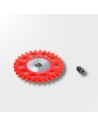
In the world of slot racing, all-wheel drive is one of the major technical challenges. A well-tuned 4WD system can make the difference between a car that slides out in the corners and one that exits straight and controlled. The pulley and belt transmission is the heart of these setups: a seemingly simple assembly that hides much more than it appears at first glance. Here you will find pulleys, belts, and all the necessary components to assemble, adjust, or improve the transmission system of your all-wheel drive models, whether for federated competition, rally, or simply to enjoy each session at home more.
Unlike classic pinion systems — where each tooth transmits torque directly and somewhat abruptly — belt transmission introduces an elastic element that smooths the drive, reduces noise, and protects mechanical components from shocks and spikes in tension. The result is a more progressive power delivery, a highly valued feature in rally-slot and raid configurations, where control over uneven terrain is essential. But also on technical asphalt circuits, where softening rear traction can significantly improve cornering performance.
Within this category, you will find components for the most common 4WD systems in the Spanish competition scene: pulleys for 3/32" (2.38 mm) axles in aluminium or technical plastic, and belts in different materials — high-strength rubber and silicone — designed for various grip, elasticity, and durability requirements. If you frequently assemble and disassemble the transmission train, you will understand perfectly the importance of having reliable spare parts on hand.
What is pulley transmission and why is it important in slot 4WD
The transmission is the set of mechanical elements that transfer the motor's rotation to the wheels. In conventional rear-wheel drive slot cars, this function is performed by the rear axle resting on the chassis, the crown gear, and the motor pinion. However, in 4WD models, it is also necessary to transfer power to the front axle, and that is where the pulley and belt system comes into play.
The basic scheme is simple: a driving pulley, mounted on the rear axle or directly on the motor, transmits movement through a closed belt to a second pulley located on the front axle. The diameter of each pulley determines the transmission ratio between the two axles, allowing adjustment of whether the front axle turns faster, slower, or at the same speed as the rear.
This has direct consequences on the car's behaviour. A 1:1 transmission ratio distributes torque equally between the two axles. Modifying that ratio towards one axle or the other allows fine-tuning of the chassis balance for different types of circuits or driving styles. In rally or raid cars, where chassis geometry and suspension play a larger role, this adjustment is especially relevant.
Additionally, the belt acts as a damping element. It absorbs small irregularities in torque transmission, protects the gears of the rest of the drivetrain, and reduces vibrations that would be transmitted directly to the chassis in a rigid pinion system. For many competing users, this translates to fewer breakages and less need for maintenance between heats.
How to correctly choose transmission components for your slot car
The correct choice depends on several factors that should be analysed before purchasing. The first and most important is compatibility with the chassis. Not all pulley systems are interchangeable: the axle diameter, the distance between pulley centres, and the associated belt type vary by manufacturer and model. NSR, Slot.it, Avant Slot, and Scaleauto have their own standards, and mixing components without verifying measurements can result in an assembly that does not work or wears out at an abnormal rate.
The second factor is the material of the pulley. Aluminium pulleys are lighter and stiffer, which favours transmission precision and reduces rotating masses. Technical plastic pulleys are somewhat more economical and in some cases absorb vibrations better, although their durability under heat may be inferior in long competition sessions.
For the belt, the main criterion is the level of elasticity and the material. A standard rubber belt offers a good balance between grip and durability. Silicone belts are more elastic and softer, ideal for setups where maximum smoothness of torque transmission is desired; however, they may slip slightly in very aggressive starts. For federated competition where consistency is key, many drivers prefer high-strength rubber belts, which are less prone to permanent stretching.
The third element to consider is the transmission ratio. If your chassis already has a defined geometry and the car's behaviour in corners is not as desired, changing the combination of pulleys can be a tuning tool before adjusting other more critical parameters. It is a reversible, economical adjustment with a real impact on the model's dynamics.
Main types and differences
Pulleys for rear axle and front axle
Although they may seem identical at first glance, pulleys for the rear axle and those for the front are not always interchangeable. In many all-wheel drive kits, the driving pulley has a recess or a specific fastening system to mount on the axle or directly coupled to the rear pinion. Front axle pulleys are usually of smaller diameter to create a slightly faster transmission ratio on that axle, which helps keep front traction active in all-wheel drive.
Standard rubber belts
These are the most common on the market. Made from high-strength rubber, they offer a good lifespan and maintain their tension for longer. They are the most widely used option in competition and the first choice for those assembling a 4WD for the first time.
Silicone belts
Softer and more elastic than rubber ones. Suitable for setups where smoothness of transmission is prioritised over rigidity. Widely used in raid and rally-slot configurations where the chassis works more on independent axles. Their greater elasticity can cause slight transmission losses under very abrupt acceleration.
Complete transmission kits
Some manufacturers like NSR or Slot.it sell kits that include a front pulley, rear pulley, and belt matched to that combination. For those who do not want to research compatibilities, these kits are the safest and most straightforward solution.
Technical aspects we should know
Before working with the transmission system of a 4WD slot car, there are some technical concepts that should be clear to avoid assembly or tuning errors.
Belt tension: a belt that is too tight increases internal friction, heats the axles, and can bend or wear out the bearings. A belt that is too loose causes slipping and loss of synchronisation between the two axles. The correct tension allows the belt to be moved laterally with your fingers by just 1-2 mm with little pressure. If the manufacturer provides a tension guide, always follow it.
Alignment of the pulleys: the front and rear pulleys must be perfectly aligned in the same plane to prevent the belt from shifting laterally and wearing unevenly or coming off during a race. Poor alignment is the number one cause of premature belt breakage.
Diameter and number of teeth: some toothed belts (HTD type) work in exact synchronisation with the pulleys; in that case, the number of teeth on the belt must match the pitch of the pulley. Smooth belts are less demanding in this regard, but also less precise in transmission.
Influence on motorisation: in a chassis with a sidewinder motor configuration (motor parallel to the rear axle) or anglewinder (motor at an angle), the physical layout of the transmission system may vary. In inline configurations (motor in line with the axle), access to the rear pulley is usually more direct. Knowing the motor layout of your chassis is essential before choosing the transmission kit.
Practical tips for use, maintenance, and preparation
A well-maintained transmission system lasts much longer and offers consistent performance throughout the season. These are the most important points:
- Inspect the belt before each session: look for cracks, deformations, or signs of uneven wear. A damaged belt can break during a race at the worst moment.
- Clean the pulleys periodically: dust and rubber debris that accumulate on the pulleys reduce the grip of the belt and accelerate its wear. A cotton swab with isopropyl alcohol is sufficient.
- Do not lubricate the belt: unlike gears, the transmission belt operates dry. Applying lubricant to the belt or pulleys reduces grip and encourages slipping. Lubricant is reserved for bearings and axles.
- Bring spare belts to races: they are small, weigh nothing, and can save you in a knockout round. Always keep at least two belts of the model you use in your competition box.
- Check the tension after the first runs: new belts, especially rubber ones, tend to elongate slightly during the first minutes of use. Check the tension after the first laps of running.
- Store belts properly: keep them away from heat, direct light, and solvents. A poorly stored belt ages faster and loses elasticity.
Common mistakes to avoid
Working with belt transmission systems is relatively straightforward, but there are common mistakes that should be known to avoid repeating them:
- Mixing pulleys from different manufacturers without verifying compatibility: even within the same nominal diameter, the channel profile may vary. An NSR belt on a Slot.it pulley may not seat correctly and come off during a race.
- Mounting the belt with too much tension: the belief that "tighter is faster" is a classic mistake. Excessive tension adds load to the bearings, heats the system, and can bend thin axles.
- Ignoring alignment between pulleys: even a displacement of tenths of a millimetre between both pulleys in the axial plane causes lateral wear of the belt and drastically reduces its lifespan.
- Using the same belt throughout the season: belts have a limited lifespan. Even if they visually appear to be in good condition, rubber ages and loses properties. Changing them preventively is cheaper than losing a race due to breakage.
- Not verifying the transmission ratio when changing pulleys: changing the diameter of a single pulley alters the ratio between axles. If not taken into account, the car may behave unexpectedly, with the front axle turning at an unintended speed relative to the rear.
Recommendations for beginners and advanced users
If you are starting with 4WD chassis
The most sensible approach is to start with a complete transmission kit from the same manufacturer as your chassis. This eliminates variables and ensures that everything is compatible from the outset. NSR and Slot.it offer specific kits for their platforms that include everything necessary and are well documented. Once you have the system working correctly and have run for a few hours, you will have the criteria to experiment with different pulley ratios or silicone belts.
If you already have experience and want to fine-tune the setup
The transmission system is often an undervalued tuning tool. Changing the ratio between pulleys can influence the car's behaviour in subtle but real ways: a slightly faster front axle can improve corner entry; a slower one can stabilise exit. Combine these changes with belt tension adjustment and material selection to find the optimal point according to the circuit.
For rally or raid sessions on uneven surfaces, silicone belts usually perform better due to their greater absorption capacity. For technical circuits and high speeds, high-strength rubber belts offer more consistency and less variation under load.
| Type of belt |
Material |
Elasticity |
Recommended use |
Durability |
| Standard rubber belt |
Synthetic rubber |
Medium |
Asphalt competition, general use |
High |
| Silicone belt |
Silicone |
High |
Rally-slot, raid, smooth transmission |
Medium |
| Toothed belt (HTD) |
Rubber + fibre |
Low |
Precision synchronous transmission |
High |
Frequently asked questions about transmission for slot cars
Can I use any belt on my 4WD chassis?
No. You must use the belt compatible with the pulleys mounted on your chassis. The width, profile, and length must match. Check the specifications from your chassis manufacturer or those of the pulleys you have mounted before purchasing.
How often should I change the belt?
It depends on usage. In regular competition, it is recommended to inspect it after each session and change it preventively every 3-5 intense sessions or at the first sign of cracks, deformation, or loss of tension.
Are aluminium pulleys always better than plastic ones?
They are lighter and stiffer, which favours precision. However, in some setups, technical plastic pulleys work just as well and are more economical. For high-level competition, aluminium is the usual choice; for recreational or beginner use, plastic performs perfectly.
What transmission ratio is best for a technical circuit?
There is no one-size-fits-all answer: it depends on the chassis, motor, and type of circuit. As a starting point, a 1:1 ratio between pulleys is neutral. From there, try small variations and measure the car's behaviour in corners and during acceleration.
Does the belt affect motor consumption?
Yes, but minimally if the system is well adjusted. A belt that is too tight adds friction and makes the motor work harder. A properly tensioned belt offers little additional resistance.
Can I mix NSR pulleys with Slot.it belts?
In some cases, it is possible if the width and profile match, but it is not guaranteed. The safest approach is to always use components from the same manufacturer or explicitly verify the measurements before combining them.
Can silicone belts be used in federated competition?
Yes, as long as the competition regulations do not specify otherwise. They are standard market components. Check the technical regulations of your championship if you have doubts.
Why does my belt come off during a race?
The most common causes are: incorrect alignment between pulleys, insufficient tension, worn belt, or using a belt incompatible with the mounted pulleys. Check these points in that order.
What is the difference between a 4WD transmission system and a rear-wheel drive system in slot?
In rear-wheel drive, the motor only drives the rear axle. In 4WD, power is also distributed to the front axle through the pulley and belt system. This improves overall traction and can enhance stability, although it adds mechanical complexity and slightly more internal friction.
Do I need special tools to mount the pulleys?
In most cases, precision screwdrivers, a small pulley puller, and calipers to verify measurements are sufficient. Some kits include the mounting tool. Always work on a clean surface to avoid contaminating bearings or the belt.
Does belt transmission make less noise than pinion transmission?
Yes, significantly. The belt absorbs some vibrations and eliminates the characteristic metallic sound of gears. In long sessions or enclosed spaces, this difference is clearly noticeable.
What brands do you recommend for starting with a 4WD system?
NSR and Slot.it are the most solid references for starting with all-wheel drive in 1/32 scale. They have available technical documentation, good spare parts distribution, and an active community that resolves doubts. Avant Slot also has well-documented 4WD models for competition.