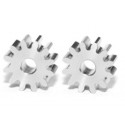
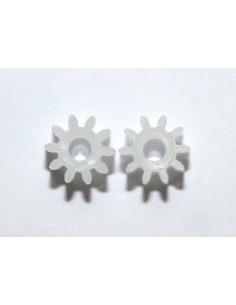
When preparing a slot car for serious racing, every tenth counts. Few decisions affect track performance as much as the choice of pinion. We are not talking about a minor component: it is the first piece of the drivetrain, the one that transforms the motor's rotational speed into actual movement on the asphalt. Changing it can make the difference between a car that accelerates brutally and one that gives you a top speed unattainable for the rival. Or between a quiet and precise chassis and one that punishes the crown gear every few minutes of running.
At Ministry of Hobby, we work with pinions for the most common configurations and motors in the world of modern slot racing: from inline setups to sidewinder and anglewinder, in scales 1/32 and 1/24, for axle diameters of 1.5 mm and 2 mm, and with different tooth counts so that each driver can find exactly the gear ratio they need according to the track, the motor, and their driving style.
This category is designed for both the pilot who is starting to tinker with their first competition car and the experienced preparer who already knows that a change from 8z to 9z can completely change the behaviour on a circuit with many chicanes. If you are looking for information to make the right decision, keep reading. If you already know what you need, the filters will take you straight there.
What is a pinion and why does it matter so much in slot racing
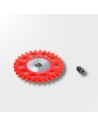
The pinion is the gear that mounts on the motor shaft and meshes with the crown gear, which is fixed to the rear axle of the car. Together they form the gear ratio, the mechanical heart of any slot car. Its function is simple to explain but its influence is enormous: they determine how many turns the rear axle —and thus the wheels— make for each turn of the motor.
The relationship between the number of teeth on the pinion and the number of teeth on the crown gear defines the gear ratio. If the crown gear has 27 teeth and the pinion has 9, the ratio is 3:1, which means the motor makes three turns for each turn of the rear axle. The higher that ratio, the more torque and acceleration; the lower, the more top speed.
This adjustment is not fixed forever: it depends on the circuit, the type of motor, the weight of the car, and the driving style. That is why competition preparers carry several pinions in their bag and test them according to the layout of the day. On a track with many slow corners, a shorter ratio is advisable (smaller pinion, more acceleration); on an oval or a fast track with long straights, a longer ratio (larger pinion, more top speed).
In addition to performance, the pinion directly influences the engine braking: a shorter ratio offers more braking when lifting the throttle, which in certain layouts helps control the entry into corners without having to adjust the electronics of the controller too much.
How to correctly choose the pinion
Choosing a pinion is not just about counting teeth. Several factors must be aligned for the setup to work well and not cause problems:
- Motor shaft diameter: The pinion must fit perfectly on the shaft. The most common in 1/32 slot racing are 1.5 mm and 2 mm. A pinion with the wrong diameter simply won't fit, or worse, it fits loosely and slips under load. Always check the motor specifications before purchasing.
- Gear module: The module defines the size of the teeth and must be compatible with that of the crown gear you are using. The most common modules in slot racing are 0.4 (the most widespread in 1/32) and 0.5 (common in 1/24 and some competition setups). A pinion and a crown gear with different modules do not mesh well even if they have the same number of teeth.
- Number of teeth: As we have seen, it determines the gear ratio along with the crown gear. The usual range in 1/32 is from 8 to 14 teeth. More teeth mean more top speed; fewer teeth mean more acceleration and more engine braking.
- Material: Brass, steel, or nylon. Each has its advantages depending on the type of motor and the intended use (we will see this in detail later).
- Motor configuration: The position of the motor in the chassis (inline, sidewinder, or anglewinder) does not change the type of pinion itself, but it does affect the available space and how it aligns with the crown gear. In some very tight anglewinder or sidewinder configurations, the outer diameter of the pinion may limit options.
If you are building a new combination from scratch, it is advisable to start with a standard gear ratio for your type of track (for example, 3:1 or 3.5:1 in 1/32 with a motor of 20,000-25,000 rpm) and from there make fine adjustments based on actual lap times.
Types of pinions and main differences
By material
Brass: It is the most commonly used material in competition slot racing. It offers a good balance between hardness, smoothness of meshing, and ease of machining. Brass pinions work well with plastic or nylon crowns without excessively wearing them, and they handle medium to high-performance motors perfectly. They are the most common in brands like NSR, Slot.it, or Scaleauto.
Steel: Greater hardness and mechanical resistance. They are the choice for high-performance motors where the torque is high and can fatigue a brass pinion over time. The downside is that they can wear plastic crowns faster if not lubricated properly. Common in intense competition setups or in 1/24 cars.
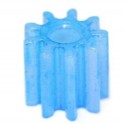
Nylon and plastic: Lighter and quieter. They reduce the transmission of vibrations and rolling noise, making them interesting in recreational cars or on circuits where noise is a factor. Their durability is lower under high load, so they are not the first choice for demanding competition.
By number of teeth
The usual range in scale 1/32 goes from 8z to 14z. For scale 1/24, the ranges are somewhat different and generally larger pinions are used. In 1/32 competition, the most common values are between 9z and 12z, depending on the motor and crown gear chosen.
By motor configuration
Although the pinion itself does not change according to the configuration, it is important that the setup is correct in each case:
- Inline: The motor is arranged longitudinally, with the motor shaft in the same direction as the rear axle (in line). The pinion meshes directly with the crown gear very efficiently. It is the configuration that most influences lowering the car's centre of gravity.
- Sidewinder: The motor is mounted parallel to the rear axle, transversely to the chassis. The pinion is on one side and engages with the crown gear from that angle. It is very common in modern competition cars because it allows for a low centre of gravity and balanced mass distribution.
- Anglewinder: The motor is positioned at an angle relative to the rear axle. It combines advantages from the two previous configurations and is common in high-performance cars from brands like NSR or Avant Slot.
Technical aspects we need to know
Beyond the number of teeth and the material, there are technical details that make the difference between a functioning drivetrain and one that causes problems:
Gear module
The module is the parameter that defines the profile and size of the teeth. In 1/32 slot racing, module 0.4 is the de facto standard. In 1/24, module 0.5 or even 0.6 is frequently used. Mixing different modules between pinion and crown gear causes poor meshing, vibrations, excessive noise, and premature wear. Always confirm that the pinion and crown gear have the same module.
Attachment to the motor shaft
Pinions are attached to the motor shaft via press fit or by a lateral tightening screw (grub screw). Press-fit pinions offer a clean attachment but require the right tool to mount and dismount them without damaging the shaft. Screw pinions allow for easier adjustment but you must ensure that the screw is tightened properly to prevent the pinion from moving under load.
Alignment
The alignment between pinion and crown gear is critical. If they are not perfectly aligned in the same plane, the contact between teeth is partial, which generates vibrations, noise, and asymmetric wear. Poor alignment can destroy a new crown gear in just a few running sessions.
Backlash
A small amount of play between pinion and crown gear is necessary for the gear to function correctly and not bind. Too much backlash results in loss of efficiency and rattling; too little play can cause the drivetrain to jam or generate excessive heat. Adjusting the correct backlash is one of the details that distinguishes an experienced preparer.
Practical tips for use, maintenance, and preparation
- Lubricate moderately: A point of specific lubricant for slot gears at the pinion-crown contact is sufficient. Excess lubricant attracts dust and dirt, degrades the grip of the tyres if it splashes, and can create a film that actually worsens the transmission.
- Check the condition of the teeth: Before each competition session, visually check that the teeth of the pinion do not show irregular wear, chips, or flattening. A damaged pinion quickly wears out the crown gear.
- Use the right tool for mounting and dismounting: A pinion puller prevents you from crushing or bending the motor shaft when removing it. It is a small investment that saves many motors.
- Store pinions in an organiser: Pinions are small and easy to lose or confuse. An organiser with cells identified by tooth count and material saves time and errors in the pit.
- Test different ratios in practice: Don't wait for the competition to know which ratio works best. Spend practice time testing at least two different ratios and compare actual lap times, not just feelings.
- Relate the pinion change to the motor: If you change motors, also check if the gear ratio is still appropriate. A new motor with higher rpm may require a different pinion to avoid being under or over-revved.
Common mistakes to avoid
Confusing the module of the pinion with that of the crown gear
This is the most common mistake among those starting to prepare cars. A pinion with module 0.4 cannot be used with a crown gear with module 0.5. It may seem to fit, but the meshing is incorrect and wear is brutal. Always check that both have the same module before mounting.
Forgetting the shaft diameter
A 2 mm pinion mounted on a 1.5 mm shaft will be loose and slip under load. A 1.5 mm pinion on a 2 mm shaft simply won't fit. It seems obvious, but it is a mistake that happens more often than it should, especially when mixing parts from different brands.
Over-tightening the pinion on the shaft
If you force a press-fit pinion too hard, you can bend the motor shaft or damage the internal bearings. Always use the appropriate tool and apply the right pressure.
Not checking alignment after mounting
Mounting the pinion and going out to run without verifying the alignment with the crown gear is a sure way to destroy both pieces in just a few laps. Turn the assembly by hand before plugging in the motor and listen: if there is irregular noise or resistance, adjust before running.
Changing only the pinion without checking the crown gear
If the crown gear already has wear, mounting a new pinion on it will only accelerate the deterioration of the pinion. When changing the pinion, take the opportunity to inspect the condition of the crown gear and, if in doubt, change both pieces at once.
Recommendations for beginners and advanced users
If you are starting
The most reasonable approach is to respect the gear ratio that comes factory-installed in your car or the one recommended by the motor manufacturer for that type of track. In most 1/32 cars with standard motors, a ratio between 3:1 and 3.5:1 (for example, 9z with a crown gear of 27z) is a balanced starting point that works well on mixed circuits.
Start with brass pinions: they are the most versatile, the easiest to find, and the ones that work best with the nylon or plastic crowns commonly found in beginner cars. Learn first to mount and align correctly before experimenting with extreme ratios.
If you already have experience
At this level, fine adjustments make the difference. Bring at least three different ratios to each competition and learn to read lap times to identify if the car needs more acceleration or more top speed. Steel pinions are worth it in high-performance motors with high torque, especially in long sessions or on tracks that require many accelerations.
Pay attention to the module and the quality of machining: low-cost pinions with wide tolerances can introduce irregularities in the transmission that are clearly noticeable in the car's behaviour. Brands like NSR, Slot.it, or Scaleauto offer precision-machined pinions that justify the price difference in competitive contexts.
Comparative table of materials
| Material |
Durability |
Smoothness of meshing |
Weight |
Recommended use |
| Brass |
High |
Very good |
Medium |
General competition, versatile |
| Steel |
Very high |
Good |
High |
High-performance motors, long sessions |
| Nylon/Plastic |
Medium |
Excellent (quiet) |
Low |
Recreational use, noise and weight reduction |
Frequently asked questions about slot pinions
What does the "z" in the number of teeth of a pinion mean?
The "z" is the standard abbreviation for "number of teeth" (from the German Zähnezahl). A 9z pinion has 9 teeth. It is the usual notation in slot and modelling catalogs.
Can I use any pinion with any crown gear?
No. The module of the pinion and the crown gear must match. In 1/32 slot racing, the most common module is 0.4. In 1/24 it can be 0.5 or 0.6. If the module does not match, the meshing is incorrect even if it physically fits.
Is it better to have more or fewer teeth?
It depends on the goal. More teeth on the pinion = higher top speed. Fewer teeth = more acceleration and more engine braking. There is no universal answer: it depends on the circuit, the motor, and the driving style.
How often should I change the pinion?
It depends on use and material. In intense competition with powerful motors, it is advisable to check the pinion every few sessions. If irregular wear appears on the teeth or the meshing starts to sound different, it is time to change it.
Does the pinion influence the motor's electrical consumption?
Indirectly, yes. A misaligned pinion or one with too much friction makes the motor work harder, which increases current consumption and temperature. A well-adjusted and lubricated drivetrain reduces the load on the motor and improves efficiency.
What tool do I need to change the pinion?
For press-fit pinions, the ideal tool is a specific puller/installer for slot (there are very affordable ones). For pinions with a tightening screw, a screwdriver or Allen key of the appropriate size is sufficient. Using pliers directly on the pinion can damage both the pinion and the shaft.
Can I mix pinions from different brands with crowns from other brands?
Yes, as long as the module and shaft diameter are compatible. For example, an NSR pinion with module 0.4 works perfectly with a Slot.it crown gear of module 0.4. The important thing is to verify the module, shaft diameter, and number of teeth, not the brand.
What gear ratio is good for starting?
For a 1/32 car with a standard performance motor (around 20,000-25,000 rpm), a ratio of 3:1 to 3.5:1 is a safe starting point. For example, a 9z pinion with a 27z crown gear (3:1 ratio) or an 8z pinion with a 27z crown gear (~3.4:1 ratio).
Do brass pinions wear out nylon crowns?
Much less than steel ones. Brass is softer than steel, which makes the wear more balanced between both pieces. For nylon or plastic crowns, brass is the most recommended option.
Is a pinion the same as a crown gear?
No. The pinion is mounted on the motor shaft and usually has few teeth (8-14z in 1/32). The crown gear is on the rear axle and has many more teeth (25-40z typically). Together they form the gear ratio that drives the car.
Does the pinion affect cornering behaviour?
Yes, indirectly. A gear ratio with more engine braking helps stabilise the entry into corners when lifting the throttle. A longer ratio with less engine braking can make the car harder to control in fast corners if the driver does not have a good hand.
Can I use the same pinion in sidewinder and inline configurations?
The pinion itself is the same, but the mounting position and alignment with the crown gear change depending on the configuration. In the same chassis, if you change the motor position, you will need to check the pinion-crown alignment again before running.