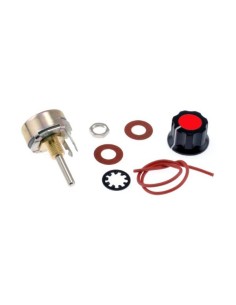
When we talk about electronics applied to slot racing, we are referring to the nervous system of any circuit. Without a good controller, there is no real control; without an adequate power supply, performance suffers; without properly installed lighting, the appearance of the cars is incomplete. Electronics is that part of the hobby that, when well chosen, goes unnoticed —everything works— and when poorly chosen, is the first thing that stands out. At Ministry of Hobby, we have been carefully selecting what goes into our catalogue for years, precisely because we know how frustrating it is to buy a component that does not fit your system or does not respond as expected during a racing session.
This category includes analogue and digital controllers, central units and modules for digital circuits, LEDs for car and pit lighting, power supplies, transformers, lap counters, and electronic accessories for the assembly and control of your circuit. Whether you are starting with your first Scalextric set or have been racing with Carrera Digital systems for years or have a permanent circuit with a dedicated lap counter, you will find what you are looking for with honest technical information.
Slot electronics have evolved significantly over the last few decades. Variable resistance controllers have coexisted with proportional trigger controllers, and digital systems have opened the door to running multiple cars on the same lane, configuring braking zones, or even managing automatic pit lanes. Not everything is compatible with everything, and that is precisely what we want you to be clear about before making a purchase.
What is slot electronics and why does it matter so much
In slot racing, electronics determine the overall driving experience. The controller is the interface between the driver and the car: its quality, the smoothness of its response curve, and its durability make the difference between precise control and a car that shoots off at every corner. But the controller does not work alone.
The power supply is the foundation of everything. A transformer that does not deliver stable voltage or that heats up during long sessions will affect the performance of all cars running on the circuit, regardless of how good their motors are. Similarly, the central unit in digital systems manages communication between the decoder of each car and the driver’s controller, assigning channels and processing information on braking, slow lane speed, and other variables.
LED lighting is another discipline within electronics. Installing front and rear lights on a slot car not only enhances realism: in night competitions or on circuits with low ambient light, the lights help visually track the position of the cars. Proper installation involves knowing the polarity of the circuit, the LED's consumption, and whether or not resistors are needed.
Lap counters, for their part, are essential tools for any enthusiast who wants to take their sessions beyond mental timing. From infrared modules to systems connected with race management software, there are options for all budgets and levels of demand.
How to correctly choose the electronics for your circuit
The first criterion is compatibility with your track system. Not all electronic components are interchangeable between systems. A Carrera digital decoder is not compatible with the Scalextric Digital system, and a central unit from one system will not recognize the modules from another. Before purchasing any electronic component, clearly identify which system you are working with.
The second criterion is the actual use you will give it. A high-end competition controller makes sense if you race in championships or if you fine-tune the setup of your cars. For occasional home use, a good mid-range analogue controller works perfectly. Investing in the controller that you will actually benefit from is smarter than buying the most expensive one in the catalogue without knowing if you will make the most of it.
The third criterion is the power of the power supply. The number of cars that will run simultaneously, the type of motors (an NSR Shark consumes more than a standard motor), and the length of the circuit determine the necessary power. An undersized power supply causes voltage drops that result in erratic behaviour, especially during maximum acceleration moments.
Finally, consider the ease of installation and configuration. Some digital systems require a significant learning curve. If you are starting with digital, consider opting for systems with intuitive software and good documentation in Spanish or with an active community.
Main types and differences
Analogue controllers
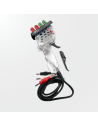
They are the historical standard of slot racing. They work by sending a variable voltage signal to the track via a resistor or transistor. They come in trigger, lever, and pistol styles. The most important difference between models is not the shape but the response curve: linear, progressive, or with braking adjustment. Competition controllers usually allow adjustment of the dead zone, braking, and power limit, making them very versatile for adapting control to each driver’s driving style.
Digital controllers
In digital systems, the controller sends a coded signal that the decoder installed in the car interprets. This allows multiple cars to run on the same lane independently. Each digital system (Carrera, Scalextric, Ninco) has its own protocol, so controllers are not interchangeable between systems without specific adapters.
Digital central units and modules
The central unit is the brain of the digital system. It manages the drivers' channels, slow lane speed, the pit lane, and, in some systems, functions like virtual fuel or simulated weather. The complexity varies greatly: from basic modules for two lanes to systems with advanced race management.
Power supplies and transformers
There are adjustable switched power supplies, classic linear transformers, and laboratory power supplies adapted for slot racing. For home use, a good brand switched power supply with a stabilized output between 12 and 15 V and sufficient amperage for the cars you will use simultaneously is usually the most balanced option. For competition, many drivers opt for laboratory power supplies that allow precise voltage adjustment.
LEDs and lighting
Lighting kits for slot racing include LEDs of various sizes (generally 3 mm or SMD), with or without built-in resistors, in different colour temperatures. There are also complete kits with wiring ready to install on specific models.
Lap counters and timing
From simple infrared modules for a single lane to multi-lane systems with race management software, sector timing, and on-screen classifications. The choice depends on the level of competition and the usual number of participants.
Technical aspects we need to know
One of the most important concepts when talking about power supplies is the difference between voltage and current. Voltage (V) determines maximum speed; current (A) determines responsiveness to simultaneous demands. A circuit with four competition cars may need peaks of 4-6 A or more. If the power supply does not deliver that current stably, the cars lose speed or behave inconsistently.
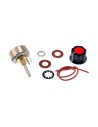
In analogue controllers, the internal resistance and the type of control component (wound resistor, transistor, or MOSFET) affect the smoothness of the response and heat dissipation. Controllers with electronic control (transistor or MOSFET) are more efficient and durable than traditional wound resistor controllers.
In digital systems, the decoder is the key component of the car. It is installed in the chassis and intercepts the signal from the track to translate it into commands for the motor. Installation requires properly soldering the power, motor, and, in some cases, light wires. A poorly installed decoder can be damaged or damage the motor.
For LEDs, it is essential to respect the polarity and calculate or include the appropriate current limiting resistor. An LED connected without a resistor to the circuit voltage will burn out in seconds. The resistor depends on the circuit's operating voltage and the LED's nominal current.
Practical tips for use, maintenance, and assembly
For power supplies: avoid operating always at the limit of the nominal power. If your power supply is 3 A and your cars demand 2.8 A continuously, it will be overworked and its lifespan will shorten. Always leave a margin of 20-30% between actual consumption and the maximum power of the supply.
For controllers: periodically clean the internal contacts if you use resistance controllers. Trigger controllers with electronic components require less maintenance, but it is advisable to store them protected from dust. If you notice a loss of response or erratic behaviour, first check the cable and connector before assuming the problem is with the controller.
For LEDs: if you install lighting on a car, secure the wiring with glue dots or kapton tape to prevent movement or vibrations during the race from breaking the solder joints. Use thin, flexible wire, ideally silicone, to avoid adding unnecessary weight or rigidity that could affect the chassis.
For lap counters: place the infrared sensor at a point on the track where the car passes at a constant speed, not just after a tight corner. This improves the reliability of the readings. Periodically clean the sensor of dust, as dirt on the emitter or receiver can cause erroneous readings.
Common mistakes we should avoid
- Mixing components from incompatible systems. A Scalextric Digital decoder does not work with a Carrera central unit. Always inform yourself before combining elements from different manufacturers.
- Undersizing the power supply. This is one of the most common mistakes. Estimating the total consumption of all cars and adding a margin is essential for a stable driving experience.
- Installing LEDs without a resistor. No matter how urgent it seems, never connect an LED directly to the circuit without a current limiting resistor. It burns out instantly and can cause a short circuit.
- Not checking the polarity when installing components. Many controllers and power supplies have connectors that can accidentally reverse polarity. Always check before turning on the circuit.
- Using wire that is too thin in high-power installations. If you add wire extensions to your power supply or circuit, ensure that the wire gauge is suitable for the current that will flow. A thin wire with high current generates heat and voltage drop.
- Neglecting track connections. Although it is not an electronic component per se, the quality of the contact between the tracks is fundamental. Oxidized or loose connections negate the effect of any good power supply or controller.
Recommendations for beginners and advanced users
If you are starting
Start with an analogue system and do not complicate yourself with digital until you master the fundamentals of driving and basic maintenance. A good analogue controller with an adjustable response curve and a stable power supply is all you need to enjoy and progress. Avoid the temptation to buy the most expensive controller in the catalogue: first learn what you value in a controller, and then make the leap.
If your set includes a standard transformer, it may be sufficient to start, but if you notice that the cars lose power or that the transformer heats up a lot, consider switching to a higher quality switched power supply. It is an investment that benefits the entire chain.
If you already have experience
Consider upgrading to a dedicated timing system if you organize races with more than two people: the difference in the racing experience is enormous. A lap counter with race management software turns an afternoon of racing into a real championship session.
To fine-tune control in competition, experiment with controllers that allow adjustment of the braking point and the progression of acceleration. In technical circuits with many slow corners, a more progressive response at the beginning of the trigger travel can make a difference in consistency and lap time.
If you install lighting, invest time in a clean and well-secured installation. A car with flickering or turning off LEDs due to vibrations is more frustrating than one without lights. The quality of the soldering and securing of the wiring is as important as the choice of the LED.
| Component type |
Main use |
Recommended level |
Compatibility |
| Basic analogue controller |
Speed control in analogue systems |
Beginner |
Universal analogue |
| Competition analogue controller |
Precise control with curve and braking adjustment |
Intermediate / Advanced |
Universal analogue |
| Digital controller |
Control in multi-lane digital systems |
Intermediate / Advanced |
Specific by system (Carrera, Scalextric…) |
| Switched power supply |
Stable power supply for the circuit |
All |
Universal (check voltage and amperage) |
| Digital central unit |
Management of cars in digital systems |
Intermediate / Advanced |
Specific by system |
| LED kit |
Car lighting |
Intermediate |
Check circuit voltage |
| Basic lap counter |
Timing via infrared |
All |
Universal (check number of lanes) |
| Advanced timing system |
Complete race management with software |
Advanced / Competition |
According to manufacturer |
Frequently asked questions
Can I use any controller with any circuit?
In analogue systems, most controllers are compatible with each other as long as the connector is the same or you use an adapter. In digital systems, each manufacturer has its protocol: a Carrera Digital controller does not control cars with a Scalextric Digital decoder and vice versa. Always check compatibility before purchasing.
What voltage do I need for my circuit?
Most 1/32 slot circuits work well between 12 and 14.8 V. Some competition drivers go up to 15-16 V with prepared motors, but for home use, 12 V is a safe and sufficient starting point. Check the specifications of your cars and motors.
How many amperes does my power supply need?
It depends on the number of cars and the type of motors. As a rough guide, a car with a standard motor consumes between 0.5 and 1 A at peak; a competition car with an advanced motor can exceed 2 A. For two domestic cars, a well-regulated 3-4 A power supply is usually sufficient.
Is it difficult to install LEDs in a slot car?
With practice and the right materials, no. You need appropriately sized LEDs, current limiting resistors, thin flexible wire, and a fine-tipped soldering iron. The biggest risk is applying too much heat with the soldering iron and damaging the LED or chassis. With patience and good securing of the parts, it is a very satisfying process.
What is the difference between an analogue system and a digital one?
In analogue, each lane has a single car controlled by a controller, and the signal is a direct variation of voltage. In digital, multiple cars run on the same lane independently thanks to decoders installed in each car that receive coded signals from the central unit. Digital allows more cars per lane, but requires more investment and has compatibility restrictions between brands.
Can I convert my analogue circuit to digital?
It depends on the track system you have. Some manufacturers offer conversion kits, but not all circuits are compatible. Additionally, you will need to install decoders in each car you want to use in the digital system, which involves basic knowledge of electronics and soldering.
Does a lap counter affect the performance of the circuit?
Well-installed infrared systems do not affect the electrical performance of the circuit, as they operate independently of the track. Systems integrated into the track may generate a slight additional resistance depending on the design, although in practice it is negligible.
What should I do if my controller loses response or stutters?
First, check the cable and connector: they are the most prone to wear. If the cable is in good condition, check the internal contacts and, in resistance controllers, the state of the wound resistor. In electronic controllers, erratic behaviour may indicate a damaged component due to overheating or a temporary short circuit.
Do digital systems have real advantages for home use?
If you regularly race with more than two people and want everyone on the same lane at the same time, digital makes a lot of sense. For one or two person use with head-to-head races, analogue offers the same fun with much less complexity and cost.
Can I use a computer power supply for my circuit?
Technically, it is possible to adapt an ATX power supply from a PC, as it delivers 12 V with quite a bit of amperage. However, it requires modifications to use it outside of a computer, and the voltage regulation is not always as stable as that of a specific switched power supply. It may work to start, but it is not the most advisable long-term solution.
What should I check if a car is slower than the others on a shared circuit?
Before looking at the electronics, check the braids and guide of the car: poor electrical contact is the most common cause. If the contact is good, check the voltage on the track at the point where the speed loss occurs: there may be a loose connection between sections. If all of the above is correct, then check the power supply and its capacity under load.